

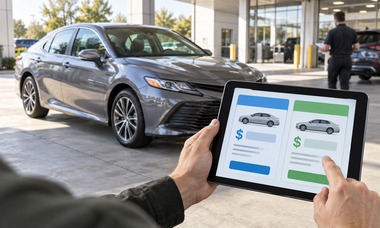
How much is your car worth as a trade-in? Kelley Blue Book (KBB) and Edmunds can give you different answers, even when you enter the same vehicle. That can be frustrating if you are trying to decide what to ask for at a dealership.
From my experience as an auto broker, I would not rely on either appraisal alone. Getting both gives you a better view of the possible trade-in value. It may also give you two opportunities to obtain an actual cash offer—something you can compare with the dealer’s appraisal before agreeing to a deal.
Is a KBB Trade-In Value the Same as a KBB Instant Cash Offer?
No. KBB’s Trade-In Range is an estimate; a KBB Instant Cash Offer is an offer you may be able to redeem at a participating dealer after the vehicle is verified. The offer may be higher or lower than a figure in the estimated range.
The trade-in estimate helps you evaluate a dealer’s proposal. The Instant Cash Offer gives you a possible alternative buyer. Keep a copy of the offer and read its terms, including its expiration date and inspection requirements.
Is an Edmunds Trade-In Appraisal the Same as a CarMax Offer?
No. Edmunds’ trade-in appraisal is an estimate, while an eligible CarMax offer obtained through Edmunds is an offer to buy the car, subject to verification. Look at the wording on your results page so you know which one you received.
An Edmunds estimate can be useful even if you do not receive an instant offer. If you do receive a CarMax offer, save it and check when it expires. You can then compare it with the dealer’s appraisal or consider selling your vehicle separately.
Should I Get Both KBB and Edmunds Appraisals Before Visiting a Dealer?
Yes. Get both Edmunds and Kelley Blue Book appraisals. It takes little time, gives you more than one reference point, and are highly regarded and perhaps begrudgingly respected by car dealers.
- Enter the same accurate vehicle details on both sites. Check the trim, options, mileage, ZIP code, condition, and any damage or mechanical issues the tools ask about.
- Save both trade-in estimates. Note whether each result is a range or a single estimated value.
- Also request actual cash offers where available as you go through the form questions. Check the box for a KBB Instant Cash Offer and a CarMax offer through Edmunds. An appraisal estimate and an actual offer are different things.
- Watch the expiration dates. And update the appraisals and/or offers just before going to a dealership to be sure they are currently accurate.
- Compare the dealer’s written appraisal. If it is lower than another offer, ask why and consider whether selling your car to the other buyer would leave you better off.
Do not average the two estimates and treat the result as your car’s exact value. Use both to understand the possible range, then compare any cash offers with what the dealership is willing to pay after inspecting your car.
Why Are KBB and Edmunds Trade-In Values Different?
KBB and Edmunds use different valuation methods, data, and assumptions, so their estimates will not always match. Both consider details about your vehicle and its market, but they may weigh those details differently.
Before focusing on the difference, make sure you are comparing the same kind of number. A trade-in value is an estimate of what you might receive from a dealer. A private-party value concerns selling directly to another person. A dealer’s retail asking price is what the dealer hopes to receive after taking on the costs and risks of selling the car. Those figures serve different purposes.
Also check that both appraisals use the correct trim, engine, drivetrain, options, mileage, ZIP code, and condition. A small difference in the information you enter can produce a noticeable difference in the result.
Which Is More Accurate for Trade-In Value: KBB or Edmunds?
Neither is consistently more accurate for every vehicle. Both provide useful estimates, but neither can tell you exactly what every dealer will pay for your particular car.
Suppose KBB estimates your trade-in at $16,000 and Edmunds estimates it at $14,800. The higher number is not automatically right, and the lower number is not automatically more realistic. A dealer may want your vehicle for its used-car inventory, or it may see repairs that reduce what it can offer.
That is why I recommend getting both appraisals. When the numbers agree, you have a stronger sense of the likely range. When they disagree, you know to investigate further and seek actual offers before setting your expectations.
What If KBB and Edmunds Give Me Very Different Values?
First, check the vehicle details and condition you entered on each site. Then request actual offers if your car qualifies. A large gap between estimates is a reason to gather more information, not a reason to assume one company made a mistake.
Pay particular attention to the condition descriptions. You may think of your car as being in excellent shape because it has been reliable and well maintained. An appraiser may also consider worn tires, paint damage, interior wear, warning lights, or repairs needed before resale.
If you have described the car accurately and the estimates still differ, save both. See what KBB’s Instant Cash Offer, an available CarMax offer through Edmunds, and the dealership itself are willing to pay. Those numbers will make the difference between the online estimates easier to put in context.
Why Might a Dealer Offer Less Than My KBB or Edmunds Appraisal?
The dealer may value your car differently after inspecting its condition, checking its history, and estimating what it will cost to prepare for resale. An online appraisal cannot see every scratch, worn tire, warning light, or mechanical issue.
The dealership’s own needs matter, too. One dealer may want your model for its lot; another may expect to send it to auction. That is one reason two dealers can offer different amounts for the same car.
If the dealer’s offer is substantially below your online estimates, ask what accounts for the difference. A specific answer helps you decide whether the lower amount is justified. You do not have to accept that offer simply because you are buying your next car there.
Can a KBB or Edmunds Cash Offer Change After Inspection?
Yes. An offer can change if the car’s condition, history, mileage, equipment, or other details do not match the information supplied online. Both KBB Instant Cash Offers and CarMax offers obtained through Edmunds involve verifying the vehicle.
Describe your car as accurately as you can when requesting an offer. If the amount changes after inspection, ask what the buyer found and how it affected the price. You can then compare the revised amount with your other offers.
How Do Two Appraisals Help Me Negotiate My Trade-In?
Two appraisals help you judge whether a dealer’s offer deserves a closer look; competing cash offers give you an alternative if the dealer will not pay enough. They are most useful when you understand the difference between an estimated value and an amount a buyer has offered to pay.
For example, imagine KBB estimates your trade-in at $15,000–$16,500 and Edmunds estimates it at $15,800–$17,000. The overlapping ranges suggest that asking for at least $15,800 may be reasonable, but they do not guarantee anyone will pay it.
Now suppose you also have a current $15,800 CarMax offer obtained through Edmunds. That gives you a specific alternative, provided your car meets the offer’s terms. You can ask the dealer to match or beat it rather than debating which appraisal website is more accurate.
What Should I Say If the Dealer’s Trade-In Offer Is Too Low?
Show the dealer your best current offer and ask whether they can match or beat it without changing the rest of the deal. Keep the conversation straightforward:
“I have an offer of $15,800 for my car. If you can match or beat it while keeping the vehicle price and fees we discussed, I’d prefer to trade it here. Otherwise, I can sell it separately.”
A valid KBB Instant Cash Offer can serve the same purpose. If all you have is a higher estimated value, you can still ask for more, but present it as an appraisal rather than an offer another buyer has committed to make.
Could a Higher Trade-In Allowance Still Be a Worse Deal?
Yes. A higher trade-in allowance may be offset by a higher purchase price, additional fees, or less favorable financing. Before agreeing to the transaction, get the figures in writing and compare the total amount you will pay.
Look at the price of the car you are buying, the dealer fees and out-the-door price, your trade-in allowance, any outstanding loan balance, and the financing terms. If you are considering selling your car separately, also check whether trading it in would give you a sales-tax benefit in your state.
The goal is to come out ahead on the whole transaction, not simply to see the largest possible number beside “trade-in allowance.”
Should I Trade In My Car or Take a KBB or CarMax Cash Offer?
Compare the net cost of both choices. Trading your car at the dealership can be convenient, and a trade-in may reduce the taxable amount of your next purchase in some states. A separate cash offer may still leave you better off if it is high enough.
Ask the dealer for a written deal with your trade-in and another without it. Compare the final amounts with what you would receive by selling the car to the buyer who made your best offer. Remember to account for any loan payoff and applicable tax treatment.
What Is the Best Way to Find Out What My Car Is Worth Before I Trade It In?
Get appraisals from both Edmunds and Kelley Blue Book, then compare any available cash offers with the dealership’s written offer. The two estimates help you understand the market. Actual offers show you what your selling choices may be right now.
You do not need KBB and Edmunds to produce the same number. Their differences give you a reason to check your assumptions, ask better questions, and arrive at the dealership with more than one source of information. If you can also obtain competing offers, you can decide where to sell your car based on the full deal—not just the first trade-in figure a salesperson presents.
What's Next?
Buying Used?
If you may be buying a used car soon, see how to identify the dealerships most motivated to get your sale, and therefore most ready to lower their price more than the rest. This is often the difference between getting a good price and getting a great one.
You'd Consider New If?
Would "new" be worth a look if you could buy close to or even below invoice, or at least at the lowest possible price when demand is high?