

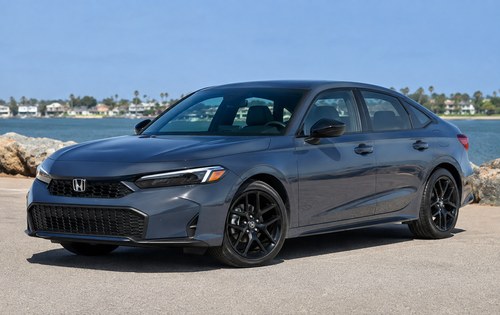
If you're shopping for a new 2026 Honda Civic, one of the most important questions isn't simply what the sticker price says. It's how much you should actually expect to pay.
And that's a more complicated question with the Civic than you might expect.
Current pricing data shows that buyers are getting discounts on many 2026 Civics, but the amount varies considerably depending on the pricing source, the trim and even which version of the Civic you're considering.
A regular Civic LX or Sport is not necessarily negotiating like a Civic Si. And the limited-production Type R operates in a very different market from an ordinary Civic sedan.
That's why I don't think there's one universal Civic discount that every buyer should expect.
To get a better picture, I've compared current pricing and transaction information from Edmunds, TrueCar, Kelley Blue Book, J.D. Power, CarWhere and other market data.
Rather than choosing whichever source reports the biggest discount, we'll look at what each one is telling us and then put the evidence together.
After that, I'll explain how much I would personally try to negotiate off a 2026 Honda Civic today — and why my target wouldn't necessarily be the same for every Civic trim.
Pricing data last checked: August 2026
What Edmunds Says About 2026 Honda Civic Prices
Edmunds is a useful place to begin because it doesn't simply show the Civic's MSRP. It also provides suggested prices intended to reflect current market conditions and what buyers are actually paying.
That distinction is important.
The manufacturer's suggested retail price tells us what Honda would like the vehicle to sell for. The more useful question for a buyer is whether the current market supports paying less.
For the 2026 Civic, Edmunds' current pricing indicates that there is negotiating room on a number of versions of the car.
Some current examples include:
| Civic Version | Edmunds Suggested Price |
|---|---|
| LX Sedan | About $25,343 |
| Sport Sedan | About $27,271 |
| Sport Hybrid Sedan | About $29,676 |
| Sport Hatchback | About $28,376 |
| Sport Hybrid Hatchback | About $30,981 |
| Sport Touring Hybrid Hatchback | About $33,551 |
These figures need to be interpreted carefully because Civic pricing differs between sedan and hatchback versions, and destination charges and individual configurations can affect the sticker price you're comparing against.
But the important takeaway at this stage is that Edmunds does not currently suggest that every Civic buyer should simply pay full MSRP.
Its current market pricing indicates some room below sticker on many mainstream Civic configurations.
See Edmunds' current 2026 Honda Civic pricing →
Before You Accept Any Civic Price, See What Other Dealers Will Offer
Edmunds can give us an excellent pricing benchmark, but it can't tell you which Honda dealer in your area is the most motivated to sell you a Civic today.
That's why I wouldn't negotiate extensively with just one dealership before finding out what several others are willing to offer.
The easiest way to begin finding that out is to request prices from several Honda dealers and compare what they're willing to offer.
Get Civic prices from multiple Honda dealers →
On the next page, select "Find Best Price" to request dealer pricing.
But before deciding whether any dealer quote is actually good, let's continue comparing the current pricing evidence.
What TrueCar Says 2026 Civic Buyers Are Paying
TrueCar gives us another perspective because its pricing estimates are based on recent transaction activity rather than simply the manufacturer's suggested price.
That's especially useful with a vehicle like the Civic because a national MSRP doesn't tell us whether buyers are routinely paying sticker, receiving modest discounts or finding dealers willing to go substantially lower.
TrueCar's current Civic pricing generally paints a more conservative picture than some of the more aggressive transaction data we'll look at later.
In other words, its data doesn't suggest that every Civic buyer should expect a huge discount.
That's worth remembering because popular Hondas don't always have to be heavily discounted to sell.
The Civic remains one of the best-known compact cars in the country, and certain versions — particularly enthusiast-oriented models — can have very different supply-and-demand characteristics from an ordinary compact sedan.
TrueCar also currently lists Honda Civic lease and financing programs, which can further complicate comparisons between one buyer's transaction and another.
A low promotional finance rate and a large dealer discount are not the same thing.
When comparing offers, I would always separate:
- The actual dealer discount from MSRP
- Any Honda manufacturer incentive
- Special financing or lease programs
- Dealer-installed accessories or mandatory add-ons
That gives you a much cleaner picture of what the dealership itself is actually doing on the price of the car.
See TrueCar's current Honda Civic pricing →
Kelley Blue Book Suggests Relatively Modest Civic Discounts
Kelley Blue Book provides another useful benchmark through its Fair Purchase Price estimates.
And much like we saw with the CR-V, KBB's current Civic numbers tend to be fairly conservative.
Some examples include:
| Civic Trim | Sticker Price | KBB Fair Price |
|---|---|---|
| LX Sedan | About $25,890 | About $25,200 |
| Sport Sedan | About $27,890 | About $27,200 |
Those examples represent discounts of only about $690 from sticker price.
On a percentage basis, that's roughly 2.5% to 2.7% below sticker.
If KBB were the only pricing source we examined, a Civic buyer might reasonably conclude that getting somewhere around $500 to $750 off MSRP represents a solid current deal.
But that's precisely why I don't want to rely on only one pricing service.
Other current Civic transaction data suggests that at least some buyers are doing considerably better.
See Kelley Blue Book's current Honda Civic pricing →
J.D. Power Shows Why an Average Price Doesn't Tell the Whole Story
J.D. Power approaches the question somewhat differently through its "What People Are Paying" data.
The particularly useful part isn't simply an average transaction figure.
It's the range of prices buyers have paid.
Current J.D. Power data for the 2026 Honda Civic shows a broad buyer-paid range, with many transactions falling approximately between the low-$22,000s and upper-$28,000s depending on configuration.
That range immediately tells us something important.
Different Civic buyers are not all paying anything close to the same price.
Some of that variation obviously comes from different trims and equipment.
But transaction ranges are still useful because they reinforce a point that matters throughout this article: an average price should be treated as a benchmark, not necessarily as the best price you can negotiate.
If one buyer pays close to sticker while another obtains a meaningful discount, the average ends up somewhere between them.
That doesn't mean you should automatically aim for the average.
It means you should find out whether you're in a position to become one of the buyers paying toward the more favorable end of the market.
See J.D. Power's current 2026 Honda Civic pricing →
CarWhere's Verified Civic Transactions Are Particularly Interesting
This is where the Civic pricing picture becomes considerably more interesting.
CarWhere currently has more than 100 verified Honda Civic transactions in its database, with its latest Civic pricing data showing buyers averaging roughly 4% below MSRP.
Unlike an advertised dealer discount, these are buyer-reported completed transactions that CarWhere says it verifies before including in its pricing data.
That makes the information especially useful when we're trying to answer the question:
What are real Civic buyers actually managing to negotiate?
CarWhere's current Civic data indicates that discounts of several percent below MSRP are not merely theoretical.
Buyers have actually completed transactions at those levels.
But there's an important wrinkle.
The negotiating picture varies by Civic trim.
Some mainstream Civic versions show considerably more discounting than others, while performance-oriented versions can behave very differently.
That means I would be very cautious about taking an overall Civic average and applying it blindly to every car carrying a Civic badge.
See CarWhere's verified Honda Civic transaction data →
The Civic Trim You Choose Can Make a Big Difference
This is one of the most important differences between the Civic and the CR-V pricing analysis.
With the Civic, the model name covers vehicles aimed at very different buyers.
There's the relatively affordable LX.
There's the popular Sport.
There are hybrid versions.
There's the enthusiast-oriented Civic Si.
And then there's the Civic Type R.
I would not walk into a Honda dealership expecting all of those vehicles to have the same negotiating room.
Mainstream Civic Sedans and Hatchbacks
The LX, Sport and hybrid models are the versions for which the broader transaction data is most useful.
These are produced and sold in much greater numbers, which gives buyers more opportunities to shop comparable cars across several dealerships.
If three or four Honda dealers have similarly equipped Civic Sports available, you have considerably more leverage than if only one dealer has the exact car you want.
The Civic Si Is Different
The Civic Si attracts a more specialized buyer and is generally available in smaller numbers.
That can reduce negotiating leverage.
In fact, Edmunds' current Si pricing illustrates why we shouldn't assume that every Civic should sell several percent below sticker.
Depending on local supply, an Si buyer may encounter considerably less willingness to negotiate than someone shopping for a mainstream Civic Sport or LX.
The Civic Type R Is Really Its Own Market
I would go even further with the Type R.
I would not use the normal Civic negotiating target we'll develop later in this article when shopping for a Type R.
The Type R is a limited-production performance model with very different demand, availability and buyer behavior.
Dealer pricing can vary dramatically, and the fact that another Civic trim is selling several percent below MSRP tells us very little about what a particular Type R dealer will accept.
For purposes of determining a realistic negotiating target, I think the Type R should essentially be treated as a separate vehicle.
So What Does the Current Civic Pricing Evidence Tell Us?
Now that we've looked at the major pricing sources individually, the differences between them become useful.
There isn't one universally accepted number for what a 2026 Honda Civic should sell for.
Instead, we have several different views of the market:
| Source | Current Indication |
|---|---|
| Edmunds | Discounting on many mainstream Civic configurations |
| TrueCar | Generally more conservative pricing |
| KBB | About 2.5%–2.7% below sticker in selected examples |
| J.D. Power | Wide range in what Civic buyers are paying |
| CarWhere | Verified transactions averaging roughly 4% below MSRP |
That's a fairly wide spread.
But collectively, the sources point toward an important conclusion:
There is negotiating room on many 2026 Honda Civics, but the amount you should target depends considerably on the Civic you're buying.
That's why I wouldn't walk into a dealership with one percentage in mind and insist that it applies equally to an LX, Sport Hybrid, Si and Type R.
How Much Would I Try to Negotiate Off a 2026 Honda Civic?
For a mainstream 2026 Civic sedan or hatchback — particularly an LX, Sport or one of the regular hybrid models — I would initially target approximately 3% to 5% below MSRP under current market conditions.
I would consider a legitimate discount of around 5% below MSRP a very good result on many mainstream Civics.
If a dealer is willing to go materially beyond 5%, I'd consider that particularly strong — assuming, of course, that the dealership isn't recovering the discount through unwanted accessories, excessive fees or unfavorable financing.
- Reasonable initial target on many mainstream Civics: approximately 3%–5% below MSRP
- Very good deal: approximately 5% below MSRP or somewhat better
- Particularly strong deal: materially more than 5% below MSRP without expensive add-ons or unusual conditions
I would be more conservative with the Civic Si.
Availability can be tighter and the buyer pool is more specialized, so the discount available on an LX or Sport shouldn't automatically become your target for an Si.
And as discussed earlier, I would exclude the Type R from these targets altogether.
The Type R operates in a sufficiently different market that it deserves to be evaluated separately.
What Does That Discount Mean in Actual Dollars?
Percentage discounts are useful for comparing vehicles, but most buyers ultimately want to know how many dollars they're trying to save.
Here are some simple examples:
| MSRP | 3% Off | 5% Off |
|---|---|---|
| $26,000 | $780 | $1,300 |
| $28,000 | $840 | $1,400 |
| $30,000 | $900 | $1,500 |
| $33,000 | $990 | $1,650 |
So on a Civic with an MSRP around $30,000, a 3% to 5% discount represents approximately $900 to $1,500 off MSRP.
That's meaningful money.
But I wouldn't walk into a Honda dealership and simply announce:
"I want 5% off."
I'd use the pricing research as a benchmark and then find out what several Honda dealers are actually willing to do.
Why One Honda Dealer May Discount a Civic More Than Another
This is one of the most important parts of buying a new car, and it's something national pricing averages can't tell you.
Two Honda dealerships selling the same Civic can have completely different reasons for deciding how aggressively they're willing to price it.
One dealer may have plenty of Civics in stock.
Another may have only a few.
One dealership may be trying to hit a monthly sales objective.
Another may already be comfortably ahead of its target.
One dealer may have had a particular Civic sitting in inventory longer than expected.
Another may have received the same car yesterday.
That's why I wouldn't spend hours trying to force one dealership to accept the price I want.
I'd find out which dealer already has the strongest reason to give me a better price.
Don't Negotiate With Just One Honda Dealer
Suppose you're shopping for a Civic Sport and contact four Honda dealerships.
You might receive offers that look something like this:
| Dealer | Discount |
|---|---|
| Dealer A | $450 |
| Dealer B | $900 |
| Dealer C | $1,250 |
| Dealer D | $1,500 |
If you had contacted only Dealer A, you might have spent an hour negotiating and eventually felt good about getting another $200 or $300 off.
Meanwhile, Dealer D may have been willing to start $1,000 lower.
That's why I prefer creating competition before doing much traditional negotiating.
Get several prices first.
Then compare them carefully.
And don't automatically assume the lowest initial quote is the lowest price that dealer will accept.
Now Test Your Target Against Actual Civic Dealer Prices
At this point you have a reasonable idea of what current Civic pricing data suggests and what kind of discount may be worth targeting.
The next step is finding out what Honda dealers in your market are actually willing to offer.
Request and compare Honda Civic dealer prices →
On the next page, select "Find Best Price" to request dealer pricing.
Once you have several offers, compare the actual selling prices and identify the strongest one.
Then, if you choose, give the other dealerships another opportunity to beat it.
That's often considerably more effective than walking into one dealership without knowing what its competitors are willing to do.
Make Sure You're Comparing Similar Civics
Dealer competition works best when you're comparing vehicles that are genuinely similar.
A Civic Sport with no dealer-installed equipment isn't directly comparable to another Civic Sport carrying $1,500 worth of accessories.
Likewise, sedan and hatchback pricing differs, as does pricing between gasoline and hybrid versions.
When requesting quotes, pay attention to:
- Exact trim
- Sedan or hatchback
- Gasoline or hybrid powertrain
- Factory options
- Dealer-installed accessories
- Destination charge
- Dealer fees
The closer the vehicles are to one another, the more meaningful the price comparison becomes.
Watch for Dealer Add-Ons That Erase the Discount
A dealer can advertise an impressive Civic discount and still end up being the more expensive place to buy the car.
For example, suppose a dealer offers:
$1,500 below MSRP
but then adds:
- $995 protection package
- $399 VIN etching
- $299 nitrogen or tire package
- Other mandatory dealer-installed accessories
The headline discount suddenly doesn't look nearly as impressive.
Another Honda dealer offering only $1,200 below MSRP with none of those additions could easily provide the better deal.
That's why I wouldn't compare dealer offers based solely on the amount advertised below MSRP.
Ask for an itemized breakdown and ultimately compare the out-the-door price.
Trading In Your Current Car?
A great price on your new Civic can be offset by a weak trade-in offer. Before accepting the dealer's number, learn what you may not know about dealer trade-in offers.
Don't Confuse Honda Incentives With a Dealer Discount
This is another area where a seemingly large discount can become misleading.
Suppose Honda is offering an incentive for which you qualify and a dealership advertises a Civic at $1,000 below MSRP.
You need to know where that $1,000 is actually coming from.
If Honda is providing the money, the dealership itself may not be discounting the car very much at all.
Whenever incentives are involved, separate the transaction into three questions:
- How much is the dealer actually discounting the Civic?
- What additional incentive is Honda providing?
- Can the dealer discount and manufacturer incentive be combined?
The same principle applies to promotional financing.
A low APR can be extremely valuable, but it isn't the same thing as getting a lower selling price.
And some offers may require choosing between promotional financing and another incentive.
Check Honda's current Civic offers and incentives →
Flexibility Can Help You Get a Better Civic Price
The more narrowly you define the exact Civic you must have, the fewer dealers you'll be able to shop against one another.
If you insist on one particular trim, one exterior color, one interior color and a specific option combination, you may discover that only one or two dealerships within a reasonable distance have the car.
Your negotiating leverage immediately becomes weaker.
If several colors or configurations would work for you, your choices expand.
And so does the number of dealerships that may have a reason to offer you an aggressive price.
This doesn't mean buying a Civic you don't want simply to save a few hundred dollars.
It means recognizing that flexibility creates more opportunities to find the dealer most motivated to sell.
Should You Wait for a Better 2026 Civic Deal?
That's difficult to answer universally because incentives, inventory and dealer motivation can change quickly.
As the model year progresses and newer inventory eventually begins arriving, dealers may become more motivated to move remaining 2026 Civics.
But waiting also has a cost.
The exact trim or color you want may disappear.
An attractive finance offer could end.
And a dealer willing to make an unusually aggressive deal today may not have the same reason to do it next month.
Rather than trying to perfectly time the market, I'd concentrate on whether the price available today compares favorably with current transaction data and competing dealer offers.
If several dealerships have been given an opportunity to quote the car and one produces a genuinely strong offer, you've created a much better basis for deciding than simply hoping prices will eventually fall.
My Bottom Line on 2026 Honda Civic Pricing
The current pricing evidence shows that many 2026 Honda Civic buyers have room to negotiate below MSRP.
But unlike a vehicle where nearly every trim behaves similarly, the Civic lineup requires some judgment.
Kelley Blue Book currently suggests fairly modest discounts in the examples we examined.
TrueCar also provides a relatively conservative view of the market.
J.D. Power shows a wide range in what buyers are actually paying.
Edmunds indicates negotiating room on many mainstream Civic configurations.
And CarWhere's verified transaction data shows buyers averaging roughly 4% below MSRP, demonstrating that meaningful discounts are being achieved in actual transactions.
Based on the pricing data available in August 2026, I would initially target approximately 3% to 5% below MSRP on many mainstream Civic sedans and hatchbacks.
A legitimate discount around 5% or somewhat better would strike me as a very good result under current conditions.
I'd lower my expectations somewhat when shopping for a Civic Si if local availability is tight.
And I would treat the Type R separately rather than applying these targets to it.
Most importantly, I wouldn't decide what constitutes a good Civic price based on one dealership's offer.
Use the pricing services as benchmarks.
Then get actual prices from several Honda dealers and see what your local market will really do.
The goal isn't simply to negotiate a Civic down to an arbitrary percentage. It's to find the Honda dealer that's most willing to sell you the Civic you want at the lowest overall price.
If you're also considering waiting for the next model year, see when it makes sense to buy a 2026 rather than wait for the 2027.