

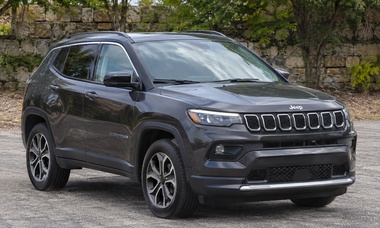
The Jeep Compass can be a practical and reasonably dependable used SUV, especially if you choose the right year and engine. It offers Jeep styling, a comfortable driving position, and available four-wheel drive; the Trailhawk adds useful off-road capability.
But the Compass has changed considerably over the years, and its reliability record isn't consistent. Earlier models can have transmission and age-related problems, while some 2017–2022 vehicles with the 2.4-liter engine have raised oil-consumption or drivability concerns. The newer turbocharged Compass is noticeably more responsive and has a different transmission.
For most buyers, I'd start with a 2023–2025 Compass, particularly a well-priced 2024. A properly maintained 2020 can also make sense on a tighter budget. This guide covers U.S.-market Compass models from 2007 through 2025.
Or, Also Considering "New"?
If you're also considering a new Compass, you may want to come back to this and take a look at a handy technique that identifies the dealer in your area most ready to make price concessions.
Overall Reliability: Is the Jeep Compass Dependable?
The Compass has a mixed but not uniformly poor reliability record. RepairPal gives it a 4.0-out-of-5.0 reliability rating, ranking it 11th among 26 compact SUVs, with average annual repair and maintenance costs of $526. Those are model-wide figures, however. Consumer Reports rates the 2021–2022 Compass below other vehicles of their years, but the 2023–2025 models about average.
Older Compasses feel less refined, the 2.4-liter engine can be sluggish, and some nine-speed automatics shift hesitantly or roughly. Electrical accessories, infotainment, and suspension wear deserve inspection too.
The most important engine change came for 2023. Jeep replaced the naturally aspirated 2.4-liter four-cylinder with a turbocharged 2.0-liter four-cylinder producing 200 horsepower, paired with a new eight-speed automatic and standard four-wheel drive. Performance improved, though long-term durability evidence is still developing.
How Many Miles Can a Jeep Compass Last?
A well-maintained Jeep Compass can reasonably reach 150,000–200,000 miles, and some go farther. Whether reaching that mileage is economical depends on maintenance and major repair needs.
At 100,000 miles, I'd look closely at oil-change records, cooling-system condition, suspension wear, and how the transmission behaves when fully warmed up. Check four-wheel-drive operation where equipped. On a 2.4-liter Compass, ask whether the owner ever needed to add oil between changes; regular low-oil warnings shouldn't be dismissed as normal.
At 150,000 miles, documented repairs often matter more than the odometer. Older CVT-equipped models, in particular, deserve careful consideration because a major transmission repair could exceed the value of the vehicle.
Budget for normal wear items such as brakes, wheel bearings, suspension parts, mounts, and cooling-system repairs. A knowledgeable independent mechanic is particularly valuable on higher-mileage examples.
What Are the Best Jeep Compass Years to Buy?
2024–2025 Jeep Compass: Best Overall Choices
These are my first choices if the budget allows. Their 200-horsepower turbocharged engine and eight-speed automatic outperform the previous drivetrain, and the refreshed interior feels modern.
Consumer Reports characterizes reliability for both years as about average relative to other vehicles of the same model year. That isn't a trouble-free guarantee. Check for warning lights, oil or coolant leaks, proper four-wheel-drive operation, and a complete service history. I'd lean toward a 2024 when the purchase price is meaningfully lower than a comparable 2025.
2023 Jeep Compass: Best Entry Into the Newer Powertrain
The first Compass with the turbocharged engine and eight-speed automatic may cost less than a 2024–2025. Every U.S. trim had four-wheel drive. Consumer Reports rates its reliability about average, despite the new powertrain.
I'd compare a 2023 directly with 2024 models on price, condition, and warranty remaining. Confirm that its instrument-panel and rearview-camera recall work has been completed where applicable, and test the infotainment system carefully.
2020 Jeep Compass: A Lower-Priced Possibility
A well-kept 2020 is a possible budget choice. Consumer Reports rates it about average, but it retains the slower 2.4-liter engine and, on four-wheel-drive versions, the nine-speed automatic. Check shifting and oil history.
There were reports of unexpected engine shutdowns accompanied by high-coolant-temperature messages in certain 2019–2020 vehicles. Federal safety regulators investigated but closed the inquiry without requiring a recall after finding a low reported failure rate. I wouldn't reject every 2020 over that issue, but I would avoid an individual vehicle with unexplained stalling or repeated temperature warnings.
Which Jeep Compass Years Should You Avoid?
These aren't universal failures, but they are the versions I'd scrutinize most carefully.
2007–2016: Older Models, Particularly With a CVT

The original Compass is now an aging budget SUV. Some versions used a continuously variable automatic transmission (CVT), and a worn or failing CVT can make an inexpensive purchase costly to keep. Beginning in 2014, many models offered a conventional six-speed automatic, but certain four-wheel-drive configurations still used the CVT. Verify the actual transmission rather than assuming the year tells the whole story.
Check for rust, suspension wear, cooling leaks, and neglected maintenance. Some 2016 vehicles were recalled for crankshaft or camshaft sensor problems that could cause engine stalling. An older Compass isn't automatically a bad buy, but I'd want a substantial price advantage and a thorough inspection.
2017–2018: Early Redesign and Oil-Consumption Concerns
First, be aware that Jeep sold two entirely different Compass designs as 2017 models. The outgoing first-generation version was sold alongside the much-improved redesigned Compass. Check which one you're actually considering.
Certain redesigned 2017–2018 models equipped with the 2.4-liter engine were covered by a manufacturer warranty extension for excessive oil consumption. The service bulletin applies to specified engines and build dates, not every Compass. The seven-year/100,000-mile extension provided for an oil-consumption test and potentially an engine replacement on qualifying vehicles. Much of that coverage has now expired, so verify any remaining eligibility by VIN.
Low oil levels can damage the engine; request consumption-test and repair records. Some 2018 vehicles were also recalled for a potentially defective engine oil pump that could cause stalling. Confirm recall completion using the VIN.
2019: Engine and Drivability Complaints
The 2019 still has the 2.4-liter engine, and Consumer Reports rates it below other cars from the same model year. I'd check for oil loss, rough or delayed shifting, warning lights, and previous stalling complaints. The 2019 was also part of the limited NHTSA investigation involving unexpected high-temperature warnings and engine shutdowns discussed above.
A well-maintained 2019 may be fine, but the price should reflect the added concerns.
2021–2022: Attractive Updates, but Check Electronics and Shifting
The 2022 brought a better interior and added safety features. However, both years rate below average for reliability in Consumer Reports, with infotainment and display complaints among 2022 owners.
Both also retain the 2.4-liter engine. Test phone connections, touchscreen, backup camera, and dashboard displays; then drive long enough to assess acceleration, transmission behavior, and any warning messages. Certain 2022 Compasses were included in recalls for instrument-display or rearview-camera issues. Check the VIN rather than relying on the seller's assurance that the software is current.
Buyer Tip: Whatever year you're considering, ask to see the Compass start cold, check the oil level, take a proper test drive, and arrange an independent pre-purchase inspection. You can verify outstanding safety recalls at NHTSA's VIN recall lookup. A service bulletin, warranty extension, and safety recall are not interchangeable.
Also, evaluating a Compass for a possible purchase is a very important first step. The next step would be learning how to actually get an excellent used Compass price, and I have some important pointers on that.
Final Verdict: Is a Used Jeep Compass a Good Buy?
Yes, a used Jeep Compass can be a good buy if you want an affordable, Jeep-styled compact SUV and choose carefully. It isn't the segment's undisputed reliability leader, but it offers useful everyday practicality, available off-road capability, and reasonable ownership costs in the right example.
I'd start with a 2024–2025, consider a 2023 for better value, and look at a well-maintained 2020 if the budget is tighter. I'd be much more selective with older CVT-equipped Compasses, early redesigned 2.4-liter models with questionable oil history, and any vehicle with unresolved shifting or electrical problems.
Choose the Compass with good service records, a clean inspection, completed recalls, and a price that reflects its condition.
Also, Your Current Vehicle
It's good to always know the value of your present vehicle, whether you plan to trade it, sell it, or simply keep track of its value as an asset.
I think the two most accurate trade-in appraisal services are Edmunds and Kelley Blue Book.
By averaging the two appraisals you'll have a very good idea of what your car is actually worth. They're both free, of course, and only take a couple minutes.