

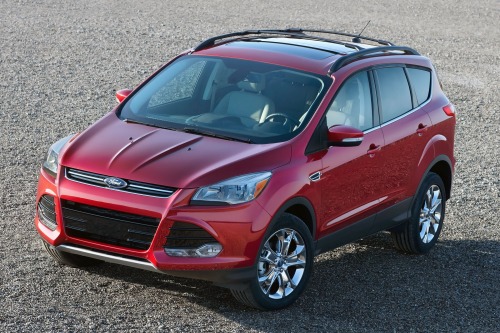
For years the Ford Escape has been a solid choice in the small crossover SUV segment. And with a major redesign for the 2013 model, the Escape had elevated its standing still further performance-wise as one of the top choices in a segment loaded with strong rivals.
Then based on Ford's European version, the Kuga, and sharing its platform with the Ford Focus, the 2013 Escape was rejuvenated with sporty design lines and energized with athletic driving dynamics.
The cabin also became roomier and more upscale, while the materials quality was upgraded and the rear seat made more functional and easier to fold down. In addition, new high-tech features included a nifty "hands-free" power liftgate and the MyFord Touch electronics interface.
That said, this Escape developed some mechanical issues that a prospective buyer should be on the lookout for before buying.
More On Ford Escape Reliability
To compare different model years and engines for the Escape, be sure to see our Ford Escape Reliability And Possible Problems Guide. This comprehensive guide highlights the best years to buy or avoid, common problems, potential maintenance costs, and more, and may help you make the right choice to meet your needs.
2013 Ford Escape Reliability
The 2013 Ford Escape marked the beginning of a completely redesigned generation, replacing the boxy previous model with a more modern crossover featuring improved fuel economy, better handling, and additional technology. While the redesign was a major step forward, it also introduced several reliability concerns that make the 2013 model less dependable than later Escape model years.
Three engines were available: a naturally aspirated 2.5-liter four-cylinder, a turbocharged 1.6-liter EcoBoost four-cylinder, and a turbocharged 2.0-liter EcoBoost four-cylinder. Of these, the 2.5-liter engine has proven to be the most reliable and least expensive to own over the long term. The EcoBoost engines provide noticeably stronger performance and better fuel economy but have experienced more cooling system and engine-related problems as they age.
The six-speed automatic transmission is generally durable and capable of lasting well beyond 200,000 miles when serviced properly. Most suspension, steering, and brake components also hold up well with normal maintenance. However, buyers should pay particular attention to the cooling system, engine performance, and evidence of recall repairs, especially on EcoBoost-equipped models.
Overall, the 2013 Escape is an average used SUV from a reliability standpoint. A well-maintained example with documented service history can still provide many years of dependable transportation, but buyers should be more selective than they would be with competitors such as the Toyota RAV4 or Honda CR-V. A thorough pre-purchase inspection is highly recommended.
- Overall reliability: Average
- Expected lifespan: 180,000 to 250,000+ miles with proper maintenance
- Best choice: 2.5-liter four-cylinder with complete maintenance records
- Watch for: Cooling system repairs, EcoBoost engine issues, transmission operation, and recall completion
Bottom line: The 2013 Ford Escape can be a good used SUV if it has been well maintained, but buyers should carefully inspect the engine and cooling system before purchasing. Choosing the naturally aspirated 2.5-liter engine significantly reduces the risk of expensive repairs.
- Why it's a good choice: Comfortable ride, modern interior, good fuel economy, and practical cargo space
- Biggest concern: Cooling system and engine problems on EcoBoost models
- Best version: 2.5-liter four-cylinder with documented maintenance history
- Buy only if: The vehicle has complete service records, passes a pre-purchase inspection, and shows no signs of overheating or coolant loss
The 2013 Escape remains a practical family crossover, but maintenance history is critical. Spending a little more for a well-cared-for example can greatly improve your chances of owning a reliable SUV for years to come.
2013 Ford Escape Common Mechanical Problems
Although the redesigned 2013 Ford Escape offers good driving manners and modern features, it also has several well-known mechanical problems that buyers should understand before purchasing. Most of these issues are concentrated around the EcoBoost engines, while the naturally aspirated 2.5-liter four-cylinder has a much stronger reliability record.
- Engine overheating (1.6-liter EcoBoost): The most significant problem involves coolant leaks that can lead to engine overheating. Ford issued multiple recalls and service campaigns to address this issue. Verify that all recall work has been completed by checking the vehicle's VIN.
- Coolant intrusion (1.5- and 2.0-liter EcoBoost): While this became far more common on later model years, some higher-mileage 2.0-liter EcoBoost engines have experienced coolant entering the cylinders, leading to rough running, coolant loss, misfires, and, in severe cases, complete engine replacement.
- Transmission hesitation: The six-speed automatic transmission is generally reliable, but some vehicles develop delayed engagement, harsh shifting, or hesitation during acceleration. A thorough test drive should include both city and highway driving.
- Turbocharger problems (EcoBoost models): As mileage increases, some turbocharged Escapes develop boost leaks, wastegate issues, or turbo wear that can reduce power and trigger check-engine lights.
- Electronic throttle body failure: Some owners report sudden loss of engine power accompanied by a wrench warning light. In many cases, replacing the electronic throttle body resolves the issue.
- Door latch recalls: Certain vehicles were recalled because faulty door latches could fail to remain closed. Confirm that recall repairs have been completed.
- Suspension wear: Front sway-bar links, struts, and control arm bushings commonly wear after 100,000 miles, producing clunking noises over bumps and reducing ride quality.
- Minor electrical issues: Backup cameras, MyFord Touch infotainment systems, door sensors, and various electronic modules occasionally develop problems as the vehicle ages.
Fortunately, many of these issues develop gradually and can often be identified during a careful inspection. Reviewing maintenance records and checking for completed recall repairs significantly reduces the likelihood of unpleasant surprises after purchase.
Buyer Tip: If reliability is your highest priority, the 2.5-liter four-cylinder is the safest choice. If you're considering an EcoBoost model, verify recall completion, inspect carefully for any history of coolant loss or overheating, and have a qualified mechanic perform a pre-purchase inspection before buying.
2013 Escape Pros:
Capable Road Manners:
Despite sharing the Focus's platform, the Escape's heavier weight and higher center of gravity prevents it from duplicating the Focus's more competent road manners.
That said, its handling is quite impressive for an SUV thanks to healthy acceleration, plenty of grip in the curves and nicely controlled body roll. Cornering in the Titanium model is ever better due to the increased grip from its high-performance 19-inch tires.
There were actually three engine choices. Only the S model came with a 2.5-liter four-cylinder that outputs 168 horsepower and 167 pound-feet of torque. Standard on the SE and SEL models was the turbocharged 1.6-liter inline-4 that produces 178 horsepower and 184 pound-feet. And optional on the SE and SEL and standard on the Titanium was the turbocharged 2.0-liter inline-4 that's good for 240 horsepower and 270 pound-feet of torque.
The EPA-estimated gas mileage rating for the 2.5-liter is 22 mpg city and 31 mpg on the highway. The front-wheel-drive 1.6-turbocharged (EcoBoost) is rated at 23 mpg city and 33 highway, while the 2.0-liter turbocharged (EcoBoost) comes in at 22 and 30, respectively. Opting for an all-wheel-drive model reduces gas mileage performance by 1-2 mpg.
High-Tech Goodies:
Ford's very useful and popular Sync system integrates the vehicles's communication and entertainment systems to allow hands-free telephone calls and control music and other functions via voice commands.
It also got a new version of the MyFord Touch system which not only uses advanced Sync technology to integrate mobile phones, PDAs and digital media players with voice commands and touch-screen inputs, but can also receive text messages and read them aloud.
Another convenient gadget was the optional hands-free power liftgate which operates by waving a foot under the rear bumper (but only when the key fob is close by).
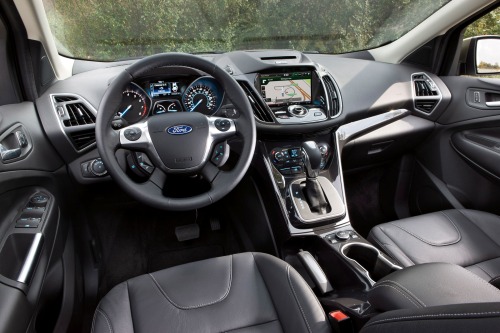
Comfortable and High-Quality Interior:
This Escape's seating is well-padded, comfortable and yet still supportive with especially wide front seats. The overall materials quality as well as the fit and finish is solid and high grade for the price point, while the gauge and feature layout is well designed and user-friendly. It's a fairly modern and attractive environment.
It's passenger room is ample for a compact SUV with plenty of leg- and headroom both front and rear. And like its sibling, the Focus, this Escape has a sporty, thick-rimmed steering wheel that lends to its carlike personality.
2013 Escape Cons:
Less Than User-Friendly Climate Controls:
While most of this Escape's controls are easy to use, the climate system is an exception. The problem mostly stems from its location, which is quite low and awkwardly positioned in front of the gear shift. This can lead to fumbling with buttons and could potentially take the driver's eyes off the road excessively, especially when first learning to use these controls.
Above Average Mechanical Problems:
Over time, costly mechanical problems have become an issue, making the long-term cost of ownership above average.
These include engine stalling caused by potential problems with fuel sensors, coolant bypass valves or the wiring harness.
Also, transmission failures at around 75,000 miles have been a more serious problem. This is a very expensive possible repair in the $4,000+ range. And since most 2013 Escapes have surpassed this mileage at this point, be very cautious or verify it has been replaced.
Overall:
Due to its design, handling, fuel economy and comfort, the 2013 Escape resides among the top in the small crossover SUV segment. However, it's higher record of mechanical issues is a major warning sign. One shouldn't be purchased without an independent pre-purchase inspection.
Other of it's contemporaries to possibly consider would include the well-balanced Chevrolet Equinox, the feature and value packed Hyundai Santa Fe, the athletic Mazda CX-5 as well as the the tried and true Honda CR-V and Toyota RAV4.
Your Trade-In
Also, it's good to always know the value of your trade-in while you're evaluating your next possible purchase. Here's a good source for a quick and accurate appraisal: free trade-in appraisal.
What's Next?
If you may be buying soon, I'd recommend reading my most effective negotiation method for used cars. It explains a quick way to identify the dealerships most motivated to deal, no matter how busy they may seem, and how to follow up once you've found them. That can be the difference between getting a good price and getting a great one.
Or, if you'd consider buying a brand-new Escape if you could get a lower-than-expected price, learn how to shop the dealer, not just the car.
And beware of "Dealer Fees": Before agreeing to a dealer's numbers, see which dealer fees are legitimate, which can be negotiated, and which can be avoided.
Also, More On Ford Reliability
If you'd like to compare different Ford models, or years, be sure to read our Ford Reliability & Problems: Best Used Fords & Years Guide. It highlights the models, best years to buy, common problems, and helps you choose the right vehicle.
An Inside Insight:
How To Get A Better Price For Your Trade-In You're not just a car "buyer". When it comes to a trade-in, you're "selling" your car as well.