


The 2013 Kia Optima is an attractive midsize sedan with a comfortable interior, good fuel economy, and strong performance, but its long-term reliability is mixed. The biggest concern is the possibility of serious engine problems on some vehicles equipped with the 2.4-liter four-cylinder and 2.0-liter turbocharged four-cylinder engines. Because of this, maintenance history and evidence of previous engine-related repairs are especially important when shopping for a used 2013 Optima.
The naturally aspirated 2.4-liter four-cylinder is the most common engine and provides adequate performance with good fuel economy. The available 2.0-liter turbo delivers considerably stronger acceleration but adds turbocharger complexity and generally carries greater long-term repair risk. Both engines have been associated with bearing wear and engine failure, making oil-change history particularly important.
The six-speed automatic transmission is generally one of the stronger parts of the Optima's drivetrain. When properly maintained, transmission failures are considerably less concerning than engine problems. Suspension and steering components also tend to hold up reasonably well, although normal age-related repairs become increasingly common after 100,000 miles.
A 2013 Optima that has received a replacement engine under a Kia campaign or warranty should not automatically be rejected. In fact, documented engine replacement can make an otherwise well-maintained vehicle more attractive, particularly if the replacement engine has accumulated relatively few miles. Buyers should verify all work through service records and the vehicle's VIN.
- Overall reliability: Average to Below Average
- Expected lifespan: 175,000 to 225,000+ miles with proper maintenance and a healthy engine
- Best choice: Well-maintained 2.4-liter model with documented service and engine history
- Watch for: Engine knocking, oil consumption, low oil levels, recall history, and evidence of previous engine replacement
Bottom line: The 2013 Kia Optima can provide comfortable and affordable transportation, but it requires more careful shopping than a Toyota Camry or Honda Accord from the same period. The condition and history of the engine should be the deciding factors.
- Why it's a good choice: Attractive styling, comfortable interior, good fuel economy, strong equipment levels, and affordable used prices
- Biggest concern: Potential connecting-rod bearing wear and engine failure
- Best version: A well-maintained 2.4-liter model with complete records and documented recall or engine-related work
- Buy only if: The engine history can be verified and the vehicle passes a thorough pre-purchase inspection
A carefully selected 2013 Optima can still represent good value, but this is not a model to purchase based on appearance, mileage, or price alone. Engine condition and documented maintenance should come first.
Is the 2013 Kia Optima a Good Year or One to Avoid?
The 2013 Kia Optima is not necessarily a year that every buyer should avoid, but it is also not one that should be purchased without careful investigation. The potential for serious engine problems makes it a higher-risk used-car purchase than several competing midsize sedans.
A well-maintained Optima with complete records, completed recall work, and either a healthy original engine or a documented replacement engine can still be worth considering. Conversely, an Optima with an unknown maintenance history, low oil level, engine noise, or questionable recall history should generally be avoided regardless of how attractive the asking price may be.
Buyer Takeaway: Consider the 2013 Optima only when its maintenance and engine history can be verified. There are enough good examples available that there is little reason to take a chance on one with unanswered questions.
Possibly Buying Soon? Avoid These Dealer Traps
Before you sign, learn:
- What you don't know about dealer trade-in offers could cost you - Which dealer fees you must pay, can negotiate, or should avoid - How to avoid giving the dealer the upper hand on a used car price - How to avoid overpaying for a new car
2013 Kia Optima Common Mechanical Problems
The 2013 Kia Optima has several issues buyers should investigate, but engine condition deserves considerably more attention than anything else. Some problems are relatively inexpensive age-related repairs, while an engine failure can dramatically exceed the value of a lower-priced vehicle.
- Connecting-rod bearing and engine failure: The most serious concern involves premature bearing wear that can produce knocking noises and eventually cause the engine to seize or fail. Certain vehicles were included in major Kia engine-related recalls and campaigns, so VIN-specific history should be checked before purchasing.
- Oil consumption: Some higher-mileage engines consume significant amounts of oil between changes. Running the engine with insufficient oil can accelerate internal wear, so check the dipstick and ask whether the owner regularly adds oil.
- Engine knocking or ticking: Persistent knocking, particularly when the engine is warm or under acceleration, should never be ignored. Unusual engine noise warrants professional diagnosis before purchasing.
- Turbocharger problems (2.0-liter turbo): Turbocharged models can develop boost-control problems, oil leaks, or turbocharger wear as mileage increases. Reduced acceleration, smoke, or unusual turbo noises deserve further investigation.
- Steering concerns: Some Optimas develop clicking, clunking, or looseness in the steering system as components in the electric power steering assembly wear.
- Suspension wear: Struts, shocks, sway bar links, bushings, and other suspension components commonly require replacement as mileage climbs beyond 100,000 miles.
- Electrical problems: Power accessories, switches, sensors, and infotainment components can develop intermittent problems as the vehicle ages.
- Brake and wheel bearing wear: Higher-mileage examples may need brake, hub, or wheel bearing repairs. Listen for humming that increases with road speed and inspect for uneven brake wear.
The good news is that many 2013 Optimas have already had significant engine-related work performed. Documentation showing proper maintenance and completed manufacturer repairs can substantially reduce the risk of purchasing one today.
Buyer Tip: Check the VIN for outstanding recalls and ask specifically whether the engine has ever been replaced. Start the vehicle completely cold, listen carefully for knocking or abnormal ticking, check the engine oil level, and have a mechanic inspect the engine before purchasing.
2013 Kia Optima Pros and Cons
The 2013 Optima offers a lot of car for the money, particularly when compared with similarly priced midsize sedans. Its biggest drawback is that potential engine problems make careful vehicle selection essential.
Pros
Stunning Design: Both inside and out, the Optima's design is modern, sleek and refined, particularly for a family sedan ... and particularly for one in this price range. It simply gets stares as it drives by.
Powerful, Fuel-Efficent Engines: The 2.4-liter four-cylinder in the LX and EX models impressively delivers 200-horsepower and 186-pound-feet of torque, while getting an an EPA-estimated gas mileage rating of 24 mpg city and 35 mpg on the highway with either transmission.
Powering the SX is a feisty 2.0-liter turbocharged four-cylinder that pumps out 274 horsepower and 269 pound-feet, while getting 22 mpg city and 34 highway. In performance tests, an SX was timed from a standstill to 60 mph in just 6.5 seconds (8.9 for the other engine).
Under the hood of the Kia Optima Hybrid is a 2.4-liter four-cylinder gasoline engine coupled with an electric motor that combined generates 206-horsepower and 195-lb-ft of torque, with a fuel economy rating of 35 city and 40 highway. And it's still able to do the 0 to 60 sprint in just 8.4 seconds, which is quite quick for a hybrid.
Attractive Cabin: The interiors of other top family sedans can usually be described with words such as "traditional", "average" and often even "bland". Quite to the contrary, the Optima's is sophisticated and lively with a distinctive European flavor.
And this makes total sense once you know that Kia's head designer came from Audi. Of course, it's still not an Audi, but there's loads of well-designed features and soft-touch materials. Even the hard plastics are higher grade.
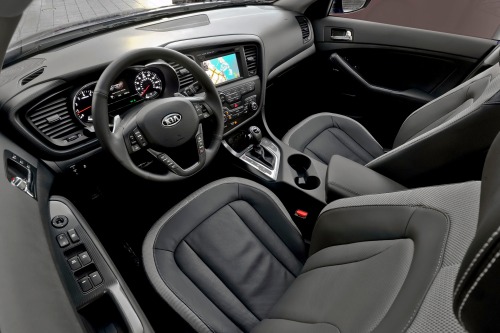
Abundant Features: There's simply a lot of features for a vehicle in this price range. Even the base LX model comes already well-equipped with standard features such as full power accessories, air-conditioning, cruise control, 16-inch alloy wheels, Bluetooth phone connectivity, keyless entry, traction control, stability control, a tilt/telescoping steering wheel, a height-adjustable driver seat and a 6-speaker audio system with satellite radio, a CD player, an auxiliary audio jack, and an iPod/USB audio interface.
Finding an upper model adds more goodies, while even upscale features most rivals don't offer, such as a panoramic sunroof or ventilated front seats, can be found as added options. And the Technology Package, for example, added navigation, a touchscreen interface, a rearview camera, real-time traffic and HD radio.
Safety - Top Crash Test Scores: In government crash testing, the Optima was given a five-star rating (out of five stars) for overall safety performance, consisting of five-star ratings for both overall frontal-impact and side-impact occupant protection. In addition, standard safety features across all models include four-wheel antilock disc brakes, traction control, stability control, side airbags, side curtain airbags, and hill start assist.
Appealing Value: When compared to other class leaders such as the Honda Accord, Toyota Camry, Volkswagen Passat and Ford Fusion, the Optima simply offers more for less. That's not to say any of these rivals don't have their own individual advantages, but given the overall package of design, features, performance, build quality and warranty, the Optima offers an awful lot of car for the dollar.
Cons
Engine failure risk: Bearing-related engine problems are the most important reason to approach the 2013 Optima cautiously.
Maintenance history is critical: A neglected Optima represents substantially more risk than one with complete service documentation.
Tight Headroom: Potential buyers should bear in mind that headroom could be somewhat of a problem for taller passengers. Rear headroom can be particularly tight due to the vehicle's attractive but sloping roof line. Models equipped with the panoramic sunroof reduces headroom further.
SX Ride Quality and Road Noise: While the LX and EX models provide a generally smooth and comfortable ride over the most typical road conditions, the SX's firmer suspension can cause it to ride on the harsh side over bumps and rough spots. In addition, its sport-tuned suspension along with its larger wheels and tires contribute to added road noise.
Oil consumption: Some engines require frequent oil-level monitoring as mileage increases.
Turbo models cost more to maintain: The additional performance comes with greater mechanical complexity and repair potential.
Lower resale value: Reliability concerns have contributed to weaker resale values than some Japanese competitors.
Hybrid Handling: While the hybrid in some situations offers impressive acceleration, while driving at low speeds or in quickly changing city traffic, it can lurch a bit while the transmission is settling on the proper gear. Its steering is also numbish and the regenerative braking system's engagement is unimpressive.
Buyer Takeaway: The 2013 Kia Optima can be an appealing bargain if you find one with a verifiable engine history and excellent maintenance records. If those records are missing or the engine shows any signs of trouble, there are safer used midsize sedans to buy.