

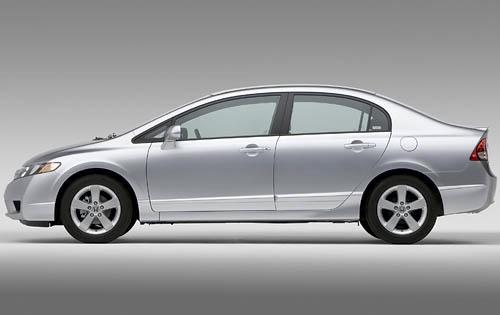
With extremely high new and used car prices, many carbuyers are looking for "older" vehicles as a way to save some significant dollars. And due to the overall popularity of the Honda Civic, the 2010 model has been getting a second look by many buyers. But, of course, now reliability and dependability have become the key issues.
Fortunately, Honda has a reputation for building reliable vehicles, and the 2010 Civic is no exception. It has proven to have a very good track record for long-term durability and low maintenance costs.
In fact, a 2010 Civic that's been well-maintained is still expected to reach over 250,000 miles, with some going even further.
So here, we'll take a look at its ...
- Reliability
- Common problems
- Pros and cons
- Price negotiation
- Original features
More On Reliability: Also, if you'd like to compare this Civic model year to the reliability of other model years, be sure to read Honda Civic Reliability & Problems: Best Used Models & Years. This comprehensive guide highlights the best years to buy or avoid, common problems, potential maintenance costs, and more, and will likely help you make the right choice for your needs.
2010 Honda Civic Reliability
The 2010 Civic is widely regarded as one of the most reliable compact cars on the used market. As one of the final years of the eighth-generation Civic, Honda had refined the platform into a dependable, fuel-efficient, and inexpensive vehicle to own.
The standard 1.8-liter four-cylinder engine is exceptionally durable and is known for its low operating costs and excellent fuel economy. The available 2.0-liter engine in the Civic Si is also highly reliable when properly maintained, although it generally costs more to insure and maintain. Both the automatic and manual transmissions have strong reliability records.
Most reported issues are relatively minor and typical of an aging compact car. Buyers should inspect for cracked engine blocks on some early-production vehicles that weren't repaired under Honda's warranty extension, worn suspension components, aging air conditioning systems, and routine maintenance history. Overall, this Civic has far fewer serious mechanical problems than many competitors.
- Overall reliability: Excellent
- Expected lifespan: 250,000 to 300,000+ miles with proper maintenance
- Best choice: 1.8-liter four-cylinder with documented maintenance records
- Watch for: Engine block warranty history, suspension wear, air conditioning performance, and routine service records
Bottom line: The 2010 Civic is one of the most dependable compact cars of its generation. A well-maintained example offers excellent reliability, outstanding fuel economy, and low ownership costs, making it an excellent used-car possibility.
- Why it's a good choice: Proven powertrain, outstanding reliability, excellent fuel economy, and low ownership costs
- Biggest concern: Verify engine block warranty repairs on affected vehicles and inspect for normal age-related wear
- Best version: 1.8-liter four-cylinder with documented service records
- Buy only if: The vehicle has been well maintained and passes a pre-purchase inspection
And I can't stress this enough:
Multiple dealers → compete for your business → you save
Additional Factors History Has Proven
Build Quality: Honda also has a strong reputation for building vehicles with high-quality materials and solid construction, resulting in a vehicle that is less prone to rattles, squeaks, and other interior and exterior issues.
Low Maintenance Costs: Owners often report relatively low maintenance costs, thanks in part to its reliable components and the availability of affordable replacement parts.
Resale Value: Because of its reputation for reliability, the 2010 Civic tends to retain its value well over time. This can be beneficial if you plan to sell or trade in the vehicle.
Availability of Parts and Service: Honda vehicles are widely popular, and as a result, replacement parts and servicing are readily available at many dealerships and independent mechanics, making it convenient to maintain the vehicle.
It's important to note that while the 2010 Honda Civic is generally considered reliable, individual experiences can vary depending on factors like maintenance history, mileage, and previous owner driving habits.
Potential Mechanical Problems:
Despite its excellent reputation for being a reliable car, like any car, it can experience mechanical issues as it ages. Here are the more common issues reported by owners that should be checked before purchase:
Transmission Problems: Some owners have reported issues with the automatic transmission, such as slipping, jerking, or delayed shifting.
Engine Mounts: Premature wear or failure of engine mounts has been reported by some owners, leading to increased vibration and noise in the cabin.
Suspension and Steering Components: Over time, components like struts, control arms, and ball joints can wear out, leading to handling issues, noise, or uneven tire wear.
Brake Problems: Owners have reported issues with the brake system, including premature brake pad and rotor wear. Regular brake maintenance is essential to avoid this.
Air Conditioning Problems: Some owners have reported problems with the air conditioning system, such as a lack of cold air or issues with the compressor.
Electrical Issues: Like many older vehicles, electrical problems may arise over time, such as issues with power windows, door locks, or lights.
Starter Motor and Alternator: Some owners have experienced starter motor or alternator failures, which can result in difficulties starting the vehicle or charging system issues.
Catalytic Converter Problems: Some Civic owners have had issues with the catalytic converter, which can be expensive to replace.
Cracking Windshields: Some owners have reported windshield issues, including cracking or chipping easily, which may necessitate repairs or replacements.
Again, it's important to note that the prevalence and severity of these issues can vary greatly from one vehicle to another. Regular maintenance and prompt attention to any emerging problems may have prevented some or all of these issues in many vehicles.
2010 Civic Pros
Fuel Efficiency: The 2010 Civic is known for its excellent fuel efficiency, making it a cost-effective choice for daily commuting and long-distance driving.
Reliability: Honda has a reputation for building reliable vehicles, including 2010 Civic. It tends to have a good track record for long-term durability as well as low maintenance costs.
Resale Value: Due to its strong reputation for reliability, Honda Civics often retain their value well, which can be beneficial when it comes time to sell or trade in the vehicle.
Comfortable Interior: The Civic's interior is well-designed and comfortable for both the driver and passengers. It offers good visibility, supportive seats, and a user-friendly layout.
Smooth Ride: The 2010 Civic provides a comfortable and smooth ride, which is particularly appreciated by those who prioritize ride quality during their daily commute.
Safety Features: The 2010 Civic typically comes equipped with a variety of safety features, including antilock brakes, front and side airbags, and stability control. Higher trim levels may offer additional safety options.
2010 Civic Cons
Limited Cargo Space: The Civic's trunk space, especially in the coupe version, is somewhat limited compared to some competitors in its class. If you need ample cargo space, you may need to consider alternative models.
Road Noise: Some owners find that the 2010 Civic can be a bit noisy on the highway, with road and wind noise being more noticeable than in some other compact cars.
Performance: While the Civic is known for its reliability and fuel efficiency, it may not be the most exciting car to drive, as its performance can be somewhat average compared to sportier rivals.
Outdated Technology: The 2010 Civic's infotainment and technology features may feel outdated compared to more modern vehicles. This is especially true for base models, which may lack advanced tech options.
Seat Comfort (for some): While many find the seats comfortable, some drivers and passengers may find the seats lacking in terms of support during long drives. Seat comfort can be a matter of personal preference.
Limited Features in Base Models: The base trim levels of the 2010 Civic may lack some of the advanced features that come standard or as options in more expensive trim levels.
And another con ... even a good price on the vehicle doesn't necessarily mean you're getting a good deal.
There are other numbers besides price that can significantly affect the final out-the-door cost. A well-negotiated selling price can quickly lose its advantage if the dealer makes up for the concession with a below-market trade-in offer. Also, dealer fees and add-ons can further increase the final cost, making it important to learn which fees you must pay, can negotiate, or should avoid.
To become better informed about these important but often-confusing parts of the deal, be sure to see my articles on trade-ins and dealer fees.
How Much Can You Negotiate on a 2010 Honda Civic?
Its negotiating room is usually about average. Although the Civic has an excellent reputation for reliability and continues to be in strong demand, its age and the higher mileage of many examples generally provide buyers with more negotiating leverage than on somewhat newer Hondas.
Here's what I'd consider realistic:
| Seller Type | Typical Negotiating Room |
|---|---|
| Private seller | 5–10% |
| Independent used-car dealer | 4–8% |
| Franchised Honda dealership | 3–7% |
| Low-mileage, exceptionally clean example | 0–3% |
| High-mileage or needs maintenance | 8–12% |
Example
If a dealer is asking $8,995:
- Excellent deal: $7,900–$8,300
- Typical purchase price: $8,300–$8,800
- Paying full asking price: Only if the car is exceptionally clean, has unusually low mileage, and comes with complete service records.
If you follow my preferred negotiating method, detailed in my Used Car Negotiation Price Guide, you'll often do better.
(For "new" cars, see my "New" Car Negotiation Price Guide.)
What Creates Negotiating Room?
You may be able to negotiate several hundred dollars more if the vehicle needs:
- New tires ($600–$900)
- Brake work ($300–$700)
- Suspension repairs such as struts or control arm bushings
- Air conditioning repairs
- Cosmetic scratches, dents, or windshield replacement
- Has multiple previous owners or an accident history
- Has been on the dealer's lot for 45–60 days or longer
My rule of thumb: For a typical 2010 Honda Civic priced between $6,500 and $10,000, I'd usually expect a successful buyer to negotiate about $600 to $1,000 off at a dealership. Larger discounts are certainly possible on higher-mileage vehicles or those needing noticeable maintenance.
Because the Civic remains one of the most desirable used compact cars, dealers generally don't discount clean examples as aggressively as many competing vehicles. Your best strategy is to compare several similar Civics at different dealerships and let them compete for your business rather than negotiating against just one seller. In my experience, that's where buyers usually achieve the biggest savings.
Features As Released in 2010
The 2010 Honda Civic was a top choice in the compact sedan/coupe segment due to its enjoyable drive, strong fuel efficiency, comfortable and well-designed cabin, wide choice of powertrains and solid reliability reputation.
By 2010, the Civic had already become iconic due to its decades of faithfully and reliably serving the driving public, worldwide. And while many automakers have been lulled into resting on their laurels, ultimately only to lose them, Honda had maintained the Civic as a leader in the small car market year after year.
Trims, Standard Features And Options:
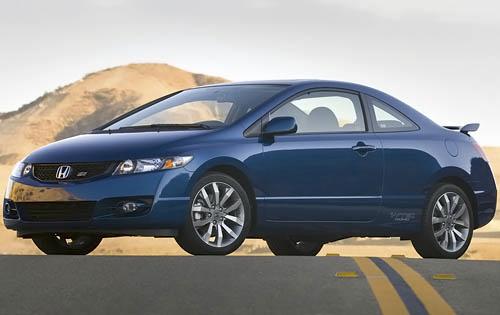
The 2010 Honda Civic is offered in both sedan and coupe versions. Both have five available trims: DX, LX, EX, EX-L and Si. There's also a DX Value Package (VP) and LX-S model for the sedan, as well as the Civic Hybrid and Civic GX natural gas model.
Standard features on the Civic DX are fairly basic and include power windows, a height-adjustable driver seat, a tilt/telescoping steering wheel and 15-inch steel wheels. No, even a stereo isn't included. But the optional Value Package for the DX offers air conditioning, a 4-speaker CD/MP3 audio system and an auxiliary audio jack.
The popular Honda Civic LX model then adds full power accessories, cruise control, keyless entry, 16 inch steel wheels, a center console, a sliding armrest and a folding rear seatback. The LX-S sedan adds alloy wheels, front sport seats, a leather-wrapped steering wheel, a rear spoiler and a chrome exhaust outlet.
Moving up to the Civic EX adds a sunroof, 16 inch alloy wheels, ambient console lighting, a 60/40-split rear seatback with a fold-down armrest and a 6-speaker audio system with steering-wheel-mounted audio controls and a USB input (the coupe also gets an exclusive subwoofer). The EX-L then adds leather upholstery, heated front seats and heated exterior mirrors.
The sport-minded Civic Si is outfitted much like the EX, but also comes with a more powerful engine, a sport-tuned suspension, sport seats, foglights, 17 inch alloy wheels, high-performance tires and special interior trim accents.
And for those interested in the more efficiency-oriented Civic models, features of the GX are similar to the LX, while the Hybrid is equipped like the EX and also adds automatic climate control.
Optional features are quite limited and include a navigation system with Bluetooth connectivity and satellite radio that is only offered on Si, EX, EX-L and Hybrid models. An additional option, heated leather seats, can also be added to the Civic Hybrid.
Engines, Powertrain And Gas Mileage:
A number of different engines can be chosen to power the front-wheel drive 2010 Civic. Powering the DX, LX and EX models is a peppy 1.8 liter four-cylinder engine that generates 140-horsepower and 128-pound-feet of torque. It's mated with a five-speed manual transmission, while a five-speed automatic is optional.
Under the hood of the 2010 Civic Si is a 197 horsepower 2.0-liter four-cylinder mated with a six-speed manual transmission only. Also equipped with a limited-slip front differential, the Civic Si goes from a standstill to 60 mph in a very quick 7.1 seconds.
The Civic GX is also powered by a 1.8 liter engine, but is fueled with compressed natural gas and produces 113 horsepower. It has a cruising range of 200 miles and a refueling machine can be installed in your garage. In terms of emissions, it's also America's cleanest internal-combustion engine car (that is mass-produced).
The Civic Hybrid employs a gasoline/electric hybrid powertrain to optimize fuel efficiency. It uses a 1.3 liter four-cylinder engine that produces 110 horsepower and is coupled with a continuously variable transmission (CVT).
Gas mileage performance is another strength of the Honda Civic. Automatic Civics with the 1.8 liter engine have an EPA gas mileage estimate of 25 mpg city and 36 mpg on the highway, while mileage for the manual comes in at 26 mpg city and 34 mpg highway.
Gas mileage ratings for the Honda Si are 21 city and 29 highway, while the GX comes in at 24 mpg city and 36 mpg highway. The Civic Hybrid leads the way with gas mileage of 40 city and 45 on the highway.
Safety:
Standard safety features on all Civic models include antilock brakes (ABS), front-seat side airbags, full-length side curtain airbags and active front head restraints. In addition to ABS, EX and Si models are equipped with four-wheel disc brakes (the others have rear drums). Also, stability control comes on EX-L, Si and Hybrid models.
In government crash tests, the 2010 Honda Civic was awarded perfect five-out-of-five-star ratings for both driver and passenger protection in front impacts. In side-impact testing, the Civic earned five stars for rear passenger protection and four stars for front passenger protection.
Interior:
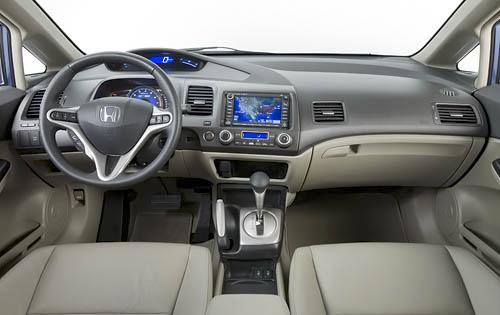
The Civic's cabin features an unusual mixture of both analog and digital instruments. The overall effect works, resulting in a unique, attractive and easy-to-read display. The build quality is excellent while the materials quality is adequate, not outstanding.
Both front and rear seating is comfortable and the rear floor is conveniently flat all the way across, making for more accommodating rear passenger quarters. Trunk storge capacity for sedans stands at 12 cubic feet, while dropping to 10 cubes for the Hybrid and 6 for the GX.
Drive:
While not engineered for an overly sporty and athletic performance, the drive and handling of the 2010 Civic is capable and confident. Most drivers will be more than satisfied with the Civic's driving performance, while enthusiasts can opt for Civic Si's sport-oriented suspension tuning and high-revving engine. Overall, the ride quality is adequately smooth and acceptably quiet.
Both the Civic Hybrid and natural-gas GX models are quite sluggish, however. While this may be acceptable in the unique GX, the Civic Hybrid has some catching up to do with the Toyota Prius, which is both faster and less expensive.
Some Inside Insights:
How To Find Motivated Honda Dealers