

While historically high new and used car prices have forced buyers to look for "older" vehicles that may have aged well as a way of saving money, the issues of reliability and dependability have become even more crucial.
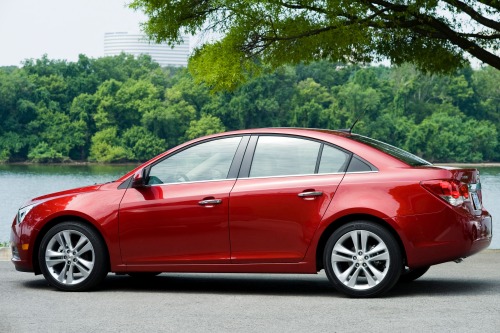
Over time, the 2013 Chevy Cruze has proven to receive mixed reviews in terms of reliability. While some owners reported positive experiences with the car, praising its fuel efficiency, stylish design, and comfortable interior, others have had problems, including with the transmission, electrical systems, and engine components.
So here, we'll review this Cruze's reliability history, it's areas of possible mechanical problems, and its overall pros and cons today.
More On Chevy Cruze Reliability
For more detailed information on the reliability of the Cruze, visit our Used Chevy Cruze Reliability Guide, a comprehensive look at the model years, engines, common problems, maintenance costs, expected lifespan, and the best years to buy or those to avoid.
2013 Chevy Cruze Reliability
The 2013 Cruze offers a comfortable ride, good fuel economy, and a refined interior, but its reliability is only average at best. While some owners have accumulated well over 150,000 miles with few major repairs, others have experienced costly engine, cooling system, and turbocharger problems that can significantly affect ownership costs.
The biggest factor in determining whether a used 2013 Cruze is a good buy is which engine it has and how well it has been maintained. The naturally aspirated 1.8-liter four-cylinder is generally the more dependable choice, while the turbocharged 1.4-liter engine delivers better performance and fuel economy but has a higher likelihood of expensive repairs as mileage increases.
Overall, the 2013 Cruze can still be a worthwhile used compact sedan if it has a documented maintenance history and passes a thorough pre-purchase inspection. Buyers should budget for more maintenance and repairs than they would with similarly aged Toyota Corolla or Honda Civic models.
Buyer Tip: Choose a Cruze with complete service records, no signs of coolant leaks, and a smooth-running engine. Spending more for a well-maintained example is often far less expensive than repairing a neglected one.
Also, if you're serious about buying soon, I'd highly recommend reading my most effective negotiation method for used cars, which details a quick way to identify the dealerships most motivated to "deal", no matter how busy they may seem, and how to follow up once you've found them. This can be the difference between getting a good price and getting a great one. And a variation of it is my top method for new cars, if you are also exploring that market.
You can see them here at used cars and new cars.
2013 Chevrolet Cruze Common Problems
The 2013 Chevy Cruze has several well-known trouble spots that deserve careful attention before you buy.
- Cooling system leaks: Water pumps, thermostat housings, coolant outlets, and plastic cooling components are known to develop leaks, especially on higher-mileage vehicles.
- Turbocharger issues (1.4-liter turbo): Turbocharged models may experience boost leaks, turbo failure, wastegate problems, or cracked PCV components, resulting in reduced power and expensive repairs.
- Valve cover and PCV failures: A failed PCV system or leaking valve cover can cause rough idling, oil leaks, increased oil consumption, and check-engine lights.
- Water pump failure: Premature water pump replacement is fairly common and can lead to overheating if ignored.
- Automatic transmission concerns: Most transmissions are durable when serviced properly, but some develop harsh shifting or delayed engagement as mileage increases.
- Oil leaks: Valve cover gaskets, oil cooler seals, and other engine seals may begin leaking after 100,000 miles.
Buyer Tip: Inspect the engine carefully for coolant residue, oil leaks, and evidence of previous cooling-system repairs. During the test drive, verify that the engine reaches normal operating temperature without overheating and that the transmission shifts smoothly through every gear.
2013 Chevy Cruze Pros
Responsive yet comfortable ride: The 2013 Chevrolet Cruze offers an impressive combination of responsive handling with a smooth and composed ride. Even with sport-tuned suspension on the 2LT and LTZ models, the ride is firmer but still quite comfortable.
And either engine choice is likely to satisfy most drivers, as the base 1.8-liter four cylinder is a competent performer while the turbocharged 1.4-liter's increased torque adds liveliness around town.
Impressive fuel economy: Depending on the model, the Cruze was one of the most fuel-efficient small cars available at the time. Although powered by the peppy 1.4 turbo, gas mileage for the Cruze Eco model still comes in at an EPA-estimated 28 mpg city and 42 mpg on the highway with the manual transmission and 26 city and 39 highway with the automatic.
The 1.8-liter in the LS model is also quite pump-friendly with an EPA rating of 25 mpg city and 36 mpg highway with the manual and 22 and 35, respectively, with the automatic. The turbocharged LT and LTZ models are also impressive, getting 26 city and 38 highway with both transmissions.
Top safety ratings: In government crash tests, the Cruze was awarded the top score of five stars (out of five) for overall safety, consisting of five stars for both frontal-impact as well as side-impact occupant protection.
In addition, all models come standard with a full array of safety features, including antilock brakes, stability control, front and rear side impact airbags, full-length side curtain airbags, front knee airbags and OnStar, which includes automatic crash notification, remote door unlocking and on-demand roadside assistance.
Attractive and quiet cabin: The interior's two-tone color schemes as well as the use of cloth or leather-look trim on the doors and dash give the Cruze a more upscale look than most of its rivals.
And while some hard plastic surfaces remain, the overall design and materials quality is very likely the best in this price range.
The cabin is also one of the quietest in its class, thanks to abundant noise insulation.
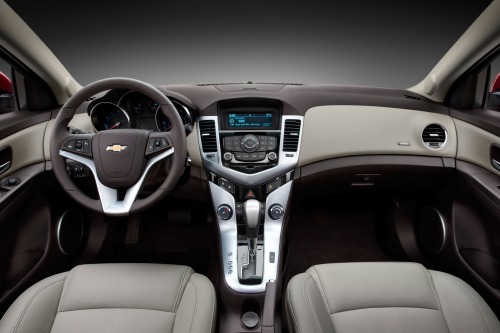
User-friendly electronics interface: The upgraded electronics interface not only adds more functionality via the Chevy MyLink system (including enhanced voice control and smartphone integration), but its also easier to use and more intuitive than previous models.
Large trunk: The trunk's more-than-generous cargo capacity of 15.4 cubic feet is much larger than the norm for the compact sedan segment.
2013 Chevy Cruze Cons
Seating comfort a potential issue: While the seats are both comfortable and supportive, those in the front may be a bit narrow for some. While in the rear, the bottom cushions are low, making the quarters more challenging for taller passengers.
True, the 5-seat cabin does offer more overall passenger space than many of its competitors, but the rear seats are best when accommodating two adults as opposed to three.
Six-speed automatic is a bit sluggish: The automatic transmission has been programmed to maximize fuel efficiency, and it's quite good at it. That said, the tradeoff is that it doesn't transition quickly between gears. It's on the reluctant side when it comes to downshifting for faster acceleration or passing unless you're very energetic on the gas pedal.
Uninspired exterior styling: The Cruze has an agreeable but undistinquished exterior design. It's on the bland side when compared to sportier-looking competitors such as the Ford Focus and Hyundai Elantra.
Acceleration and Power: Some drivers found the Cruze's acceleration and overall power to be lacking, especially when compared to competitors in the compact car segment.
Noise Levels: Some owners noted that the cabin could be noisy, especially at higher speeds, impacting overall driving comfort.
Quality of Interior Materials: While the interior design was praised, some critics mentioned that the quality of materials used in the cabin might not be as high as in some competing models.
And another con ... even a good price on the vehicle doesn't necessarily mean you're getting a good deal.
There are other numbers besides price that can significantly affect the final out-the-door cost. A well-negotiated selling price can quickly lose its advantage if the dealer makes up for the concession with a below-market trade-in offer. Also, dealer fees and add-ons can further increase the final cost, making it important to learn which fees you must pay, can negotiate, or should avoid.
To become better informed about these important but often-confusing parts of the deal, be sure to see my articles on trade-ins and dealer fees.
Rivals:
This particular segment is especially crowded with strong rivals. Others perhaps worthy of consideration would include the Ford Focus, the Honda Civic, the Hyundai Elantra, the Mazda3, the Toyota Corolla and the Volkswagen Jetta.
Also, More On Chevrolet Reliability
If you'd like to compare different Chevy models, or model years, including the Cruze, be sure to read our Chevrolet Reliability & Problems: Best Used Chevys & Years Guide. It highlights the models, best years to buy, common problems, and may help you choose the right vehicle for you.
Some Insider Insights:
How Some Buyers Are Getting Higher Trade-In Values