

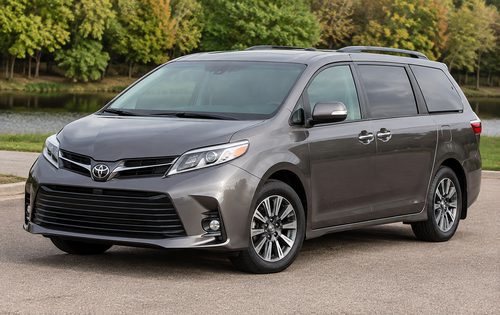
Which Toyota Sienna years are the most reliable? Which years should you avoid? And if you're shopping for a used Sienna, which engine and generation offer the best combination of durability, reasonable repair costs, and long-term value?
The Sienna has earned a strong reputation as one of the more dependable minivans, and a well-maintained example can remain useful well beyond 200,000 miles. Toyota's naturally aspirated V6 engines are a major reason, particularly the 3.5-liter V6 used extensively from 2007 through 2020.
But not every Sienna year is equally attractive. Early models are now old enough that maintenance history and age-related deterioration can matter more than their original reliability. Some older engines have timing-belt requirements, power sliding doors can become expensive trouble spots, and the 2017 introduction of an eight-speed automatic created another distinction for used buyers to consider.
This guide covers Toyota Sienna model years from 1998 through 2020, including reliability by generation, common problems, engine differences, years to avoid or inspect carefully, repair costs, expected lifespan, and the best years to buy.
Why does this guide stop at 2020? Toyota completely redesigned the Sienna for 2021 and replaced the longtime V6 powertrain with a four-cylinder hybrid system across the entire lineup. Because the 2021-and-newer Sienna has a fundamentally different drivetrain and a shorter long-term reliability history, this guide focuses on the 1998-2020 gasoline-powered Siennas with the most established high-mileage record.
In This Guide You'll Learn
- How reliable the Toyota Sienna is over the long term
- Which Toyota Sienna years are the best choices
- Which Sienna years require extra inspection
- The most common problems by generation
- Which Toyota Sienna engine is the most reliable
- What to know about timing-belt maintenance on older Siennas
- Why the 3.5-liter V6 is particularly attractive to used buyers
- What to know about power sliding-door problems
- What changed with the 2017 eight-speed automatic transmission
- How much common Sienna repairs can cost
- How long a Toyota Sienna can realistically last
However, if you're also considering a brand-new Range Rover or other new vehicle, you may want to come back to this and take a look at a handy technique that locates the dealer most ready to make concessions.
Is the Toyota Sienna Reliable?
Overall, the 1998-2020 Toyota Sienna has a very good to excellent long-term reliability record.
Its greatest strength is the durability of its basic powertrains. Toyota used naturally aspirated V6 engines throughout this period, and the better-maintained examples can accumulate substantial mileage without major internal engine repairs.
The later 3.5-liter V6 is particularly impressive. It provides considerably stronger performance than the engines in the earliest Siennas while retaining the type of durability buyers expect from Toyota.
That doesn't mean a Sienna is maintenance-free. Minivans are complicated family vehicles with power sliding doors, multiple climate-control zones, extensive interior electronics, and suspension and braking components that can receive hard use.
A Sienna that spent years transporting a large family may have accumulated considerable wear even if the engine remains excellent.
As mileage increases, buyers should expect repairs involving suspension components, wheel bearings, water pumps, motor mounts, air-conditioning systems, power doors, alternators, starters, and other wear items.
Age matters too. A first-generation Sienna may have an extremely durable engine, but a vehicle approaching 25 years old can develop problems simply because rubber, plastic, seals, hoses, wiring, and mechanical components deteriorate over time.
Bottom Line: The Sienna is one of the stronger used-minivan choices for long-term ownership. Its engines are generally a major strength, but maintenance history, power-door operation, transmission behavior, age, and overall condition should determine whether an individual van is worth buying.
Reliability at a Glance
| Category | Our Assessment |
|---|---|
| Overall Reliability | Very Good to Excellent |
| Strong First-Generation Years | 2001-2003 |
| Strong Second-Generation Years | 2007-2010 |
| Strong Third-Generation Years | 2013-2016, 2019-2020 |
| Years Requiring Extra Inspection | 1998-2000 due largely to age and maintenance history; 2004-2006 for older second-generation concerns; 2017-2018 for eight-speed transmission behavior |
| Most Proven Engine | 3.5-liter naturally aspirated V6 |
| Important Older-Van Concern | Power sliding doors and age-related deterioration |
| Expected Lifespan | 200,000-250,000+ miles with good maintenance |
Buyer Tip: Don't assume a low-mileage Sienna is automatically the better van. A 140,000-mile example with extensive maintenance records may be a much safer purchase than a neglected 80,000-mile Sienna that has spent years receiving only the minimum necessary maintenance.
Reliability by Generation
1998-2003: First-Generation Toyota Sienna
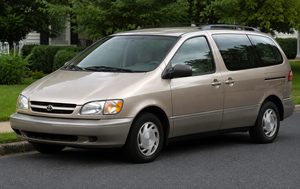
The Sienna arrived for the 1998 model year as Toyota's more conventional replacement for the unusual Previa. Instead of a mid-engine layout, the Sienna used a front-engine, front-wheel-drive platform that made it much more like the mainstream family minivans it competed against.
All first-generation Siennas used a naturally aspirated 3.0-liter V6.
The basic engine can be very durable, but these vans are now old enough that we'd place enormous emphasis on maintenance history and overall condition.
3.0-Liter V6
The naturally aspirated 3.0-liter V6 provides adequate performance and is capable of substantial mileage when properly maintained.
There are two particularly important considerations for today's buyer: oil-change history and timing-belt maintenance.
Certain Toyota V6 engines from this era developed a reputation for oil sludge when oil-change intervals were neglected or operating conditions were severe. That doesn't mean every early Sienna will develop sludge, but it makes documented oil-change history particularly valuable.
When inspecting one, we'd look for evidence of consistent maintenance rather than assuming Toyota reliability will compensate for years of neglected oil changes.
The 3.0-liter V6 also uses a timing belt. Buyers should determine when it was last replaced and whether related components such as the water pump were serviced at the same time.
Buyer Tip: On a first-generation Sienna, maintenance records are worth more to us than unusually low mileage. A documented history of regular oil changes and timing-belt service can substantially increase our confidence in the vehicle.
Oil Sludge Concerns
Oil sludge deserves specific attention on older Siennas because inadequate oil maintenance can allow deposits to accumulate inside the engine.
Severe sludge can restrict lubrication and contribute to expensive internal engine damage.
The important point is that this isn't a reason to automatically reject every first-generation Sienna. Maintenance history makes a major difference.
A properly maintained engine that has accumulated substantial mileage without symptoms is a very different proposition from a van with unknown oil-change history, visible deposits, warning lights, abnormal engine noise, or evidence of neglected maintenance.
What to Check
- Oil-change records
- Engine oil level and condition
- Visible deposits where they can be inspected safely
- Oil-pressure warning lights
- Unusual valvetrain or engine noise
- Excessive oil consumption
- Oil leaks around aging seals and gaskets
Buyer Tip: Don't try to solve a suspected sludge problem simply by aggressively flushing an unknown high-mileage engine. If you're considering buying the vehicle, determine its actual condition first.
Timing-Belt Maintenance
The timing belt is another important consideration on the first-generation Sienna.
Timing belts are scheduled maintenance items rather than evidence of poor reliability. The problem arises when a previous owner postpones the service and leaves the next owner with an overdue belt and no documentation.
Because replacing the water pump and related components can make sense while the timing-belt area is already accessible, service records showing comprehensive work are particularly valuable.
Common 1998-2003 Sienna Problems
- Oil sludge concerns when maintenance was neglected
- Timing-belt replacement requirements
- Valve-cover and other oil leaks
- Water pump and cooling-system deterioration
- Motor mount wear
- Suspension and steering wear
- Wheel bearing problems
- Power sliding-door problems on equipped vans
- Air-conditioning repairs
- Starter and alternator replacement with age
- Electrical and accessory problems on older vans
Bottom Line: A first-generation Sienna can still be a dependable inexpensive minivan, but we'd buy primarily on maintenance history and condition. The 3.0-liter V6 can last, but documented oil changes and timing-belt service are especially important.
1998-2000: Earliest Siennas Require More Inspection
We wouldn't automatically avoid the 1998-2000 Sienna, but these are now among the oldest vehicles covered in this guide.
Age alone can create expensive problems even when the basic drivetrain remains healthy. Rubber bushings, seals, hoses, wiring, cooling-system components, air-conditioning hardware, suspension parts, and interior electronics may all have experienced more than two decades of use.
For that reason, we'd only buy one when the price, maintenance history, and overall condition justify choosing such an old vehicle.
2001-2003: Our Preferred First-Generation Years
If you're specifically shopping for a first-generation Sienna, we'd concentrate primarily on 2001-2003.
These are still very old vans, so the recommendation doesn't override condition. But we'd generally prefer a later first-generation example when two otherwise comparable vehicles are available.
A well-maintained 2001-2003 Sienna with documented oil changes, recent timing-belt service, smooth transmission operation, and functioning accessories can still make sense as an inexpensive used vehicle.
Bottom Line: We'd favor 2001-2003 within the first generation, but maintenance history matters much more than a one- or two-year difference at this age.
2004-2010: Second-Generation Toyota Sienna
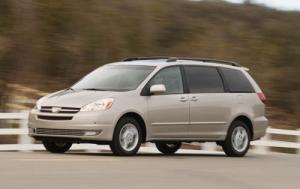
The Sienna was completely redesigned for 2004. The second generation became larger and more sophisticated and, importantly, offered all-wheel drive.
The generation also includes an important engine transition.
Earlier second-generation Siennas use a naturally aspirated 3.3-liter V6, while Toyota introduced the more powerful 3.5-liter V6 for 2007.
That change is one reason we divide the 2004-2010 generation when evaluating used examples.
3.3-Liter V6
The naturally aspirated 3.3-liter V6 used in the earlier second-generation Sienna can provide excellent service, but it retains the timing-belt maintenance requirement of the older engines.
It's smoother and more powerful than the original Sienna's engine and can accumulate substantial mileage when maintained properly.
When buying one today, we'd want to know when the timing belt was last replaced and whether the water pump and related components were addressed at the same time.
Age is becoming increasingly important on these vans as well. A mechanically healthy engine doesn't prevent expensive repairs involving doors, suspension, air conditioning, steering, or electrical equipment.
3.5-Liter V6
The introduction of the naturally aspirated 3.5-liter V6 for 2007 was an important improvement.
This engine provides substantially stronger performance while establishing an excellent long-term reliability record across numerous Toyota and Lexus vehicles.
It also uses a timing chain rather than a regularly scheduled timing belt, eliminating one of the major maintenance items associated with the earlier V6 engines.
For used Sienna buyers, the 3.5-liter V6 is our preferred engine from the 1998-2020 period.
That doesn't mean it never requires repairs. Water pumps, ignition components, seals, sensors, accessory-drive components, and other parts can wear as mileage accumulates.
But the basic engine is capable of very high mileage and is one of the major reasons later Siennas are attractive long-term vehicles.
Buyer Tip: If two second-generation Siennas are in comparable condition and similarly priced, we'd generally favor the 2007-2010 van with the 3.5-liter V6 over a 2004-2006 example.
Power Sliding-Door Problems
Power sliding doors are among the most useful features on a family minivan—and among the components we'd test most carefully on a used Sienna.
Door cables, motors, latches, rollers, switches, sensors, and related hardware can wear or fail as the van ages.
Problems may begin with a door that moves slowly, reverses unexpectedly, makes unusual noises, doesn't latch properly, or requires assistance to open or close.
Repairs can range from relatively straightforward component replacement to more involved work depending on the cause.
Test Both Sliding Doors for:
- Smooth opening and closing
- Unusual grinding or popping noises
- Slow or intermittent operation
- Doors reversing before fully closing
- Failure to latch securely
- Problems using dashboard, pillar, remote, or door-handle controls
- Damaged cables, rollers, or tracks
Buyer Tip: Don't test a power sliding door only once. Operate each door repeatedly from several controls. Intermittent problems can be easy to miss during a quick inspection.
All-Wheel-Drive Sienna Considerations
One feature that distinguishes the Sienna from most competing minivans is available all-wheel drive.
AWD can be valuable for buyers in snowy climates, but it adds drivetrain components and additional items to inspect on an older vehicle.
Check for drivetrain noises, vibration, leaking components, damaged CV boots, and mismatched tires.
Tire condition is especially important on an AWD vehicle. Ideally, all four tires should be the correct size and reasonably similar in tread depth.
AWD Siennas can be excellent vehicles, but we wouldn't pay extra for the feature unless we actually needed it.
2004-2006: Good Vans, But We'd Be More Selective
The 2004-2006 Siennas aren't inherently poor vehicles. In fact, a well-maintained example can still be a very good used minivan.
Our preference for later second-generation models comes primarily from the powertrain difference and age.
The 3.3-liter V6 requires timing-belt maintenance, while the 2007 introduction of the 3.5-liter V6 brought more power and a timing-chain design.
When prices and condition are similar, that makes the later van more attractive to us.
2007-2010: Our Preferred Second-Generation Years
The 2007-2010 Sienna is one of the more appealing older minivans for buyers who want Toyota durability without spending the money required for a much newer vehicle.
The 3.5-liter V6 is the major attraction. It's powerful, well proven, and doesn't have a regularly scheduled timing-belt replacement.
These vans are now old enough that power doors, suspension, air conditioning, motor mounts, wheel bearings, and other age-related components deserve careful inspection.
But a properly maintained example can still have substantial useful life remaining.
Common 2004-2010 Sienna Problems
- Power sliding-door cable, motor, latch, and roller problems
- Timing-belt maintenance on 3.3-liter V6 models
- Water pump and cooling-system repairs
- Oil leaks and seepage as mileage increases
- Motor mount deterioration
- Suspension bushing and strut wear
- Wheel bearing problems
- Steering-system repairs
- Air-conditioning problems
- Electrical accessory issues
- AWD drivetrain and CV-component wear
Bottom Line: The second-generation Sienna is generally reliable, but we'd give 2007-2010 models particular consideration because of the excellent 3.5-liter V6. On any van this old, power-door operation and overall maintenance history deserve nearly as much attention as the engine.
2011-2020: Third-Generation Toyota Sienna
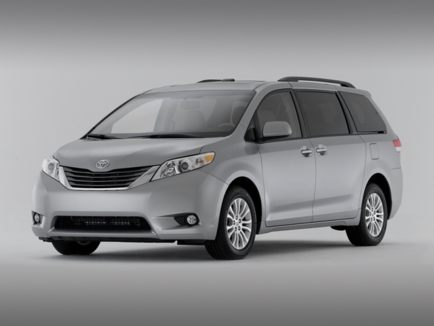
Toyota redesigned the Sienna again for 2011. The third generation retained the basic qualities that made the previous Sienna successful while providing a more modern interior, updated styling, improved technology, and continued availability of all-wheel drive.
For most of this generation, the naturally aspirated 3.5-liter V6 remained the defining engine.
There is, however, an important dividing point: 2017.
For 2017, Toyota updated the 3.5-liter V6 and replaced the previous six-speed automatic transmission with an eight-speed automatic. That makes 2011-2016 and 2017-2020 worth considering somewhat differently.
2011-2016: Proven V6 and Six-Speed Automatic
The 2011-2016 Sienna is one of our favorite periods for buyers prioritizing established mechanical reliability.
The 3.5-liter V6 provides strong performance and has an excellent durability record, while the six-speed automatic is a relatively well-established transmission.
This combination isn't immune to problems, but it avoids the additional complexity and early calibration concerns associated with the eight-speed automatic introduced later.
For someone shopping for a Sienna they hope to keep well beyond 150,000 miles, we'd give this drivetrain serious consideration.
As always, condition matters. Power sliding doors, suspension components, motor mounts, wheel bearings, air conditioning, and interior electronics can still require repairs even when the engine and transmission remain strong.
2011-2012: Early Third-Generation Years
The 2011 model year was the first year of the redesigned Sienna, so we'd inspect 2011 and 2012 examples somewhat more carefully than later versions of the same basic van.
This doesn't make them automatic years to avoid. Many have accumulated substantial mileage successfully.
But if two vehicles have similar mileage, condition, maintenance history, and price, we'd generally favor a later example after Toyota had additional production experience with the third-generation platform.
2013-2016: A Particularly Attractive Sienna Period
The 2013-2016 Siennas are among our favorite used years in the entire 1998-2020 range.
They combine the proven naturally aspirated 3.5-liter V6 with the established six-speed automatic while being substantially newer than the second-generation vans.
The 2015 model year also brought interior and structural updates, making 2015-2016 particularly interesting for buyers who want a later version of the pre-eight-speed drivetrain.
If long-term mechanical simplicity is more important to you than having the newest possible Sienna, we'd look especially closely at 2015-2016.
Buyer Tip: The newest model year isn't always our first choice when shopping for reliability. A clean 2015 or 2016 Sienna can offer a very appealing combination of age, proven engine design, and an established six-speed automatic.
2017 Powertrain Changes
The 2017 Sienna retained a 3.5-liter naturally aspirated V6, but Toyota substantially updated the engine and paired it with a new eight-speed automatic transmission.
The changes improved performance and efficiency, but they also created a meaningful distinction for used buyers.
Some owners of 2017-2018 vans have reported hesitation, unusual shift behavior, or other transmission-related concerns. That doesn't mean every eight-speed Sienna has a defective transmission, but we'd test these years carefully.
Pay attention to how the transmission behaves when cold, during light acceleration, in stop-and-go driving, when merging, and at highway speeds.
What to Check During the Test Drive
- Delayed engagement into Drive or Reverse
- Hesitation when accelerating
- Harsh or abrupt shifts
- Transmission shudder
- Excessive gear hunting
- Slipping under acceleration
- Unusual noises
- Transmission or check-engine warning lights
It's also worth determining whether applicable software updates, service campaigns, or previous transmission-related repairs were performed on the individual van.
Buyer Tip: Drive more than one 2017-2020 Sienna before buying. Comparing several examples makes it easier to distinguish normal eight-speed transmission characteristics from behavior that deserves further diagnosis.
2017-2018: Years We'd Inspect More Carefully
We wouldn't automatically avoid a 2017 or 2018 Sienna. The basic 3.5-liter V6 remains a strong engine, and many of these vans have provided reliable service.
Our caution comes primarily from the introduction of the updated powertrain and eight-speed automatic.
If a 2017-2018 van shifts smoothly, has a strong service history, passes a professional inspection, and is priced appropriately, it can still be an excellent family vehicle.
But if we had a similarly maintained 2016 and 2017 sitting next to each other, we'd generally consider the 2016's established V6 and six-speed combination particularly attractive.
2019-2020: Strong Late Third-Generation Choices
The 2019 and 2020 Siennas are among our preferred choices for someone who wants a relatively late V6-powered Sienna.
They benefit from being late in a generation that Toyota had been producing since 2011, while still retaining the naturally aspirated V6 that had accumulated an extensive reliability history.
They're also young enough that age-related deterioration should generally be less extensive than on 2000s and early-2010s vans, although mileage, family use, maintenance, and climate can create substantial differences between individual vehicles.
The 2020 Sienna is particularly noteworthy because it's the final model year before Toyota changed the Sienna to an exclusively hybrid powertrain.
Common 2011-2020 Sienna Problems and Concerns
- Power sliding-door problems
- Water pump and cooling-system repairs at higher mileage
- Oil leaks or seepage as engines age
- Motor mount deterioration
- Wheel bearing wear
- Strut, shock, and suspension bushing wear
- Brake and rotor wear
- Air-conditioning repairs
- Infotainment and electrical accessory problems
- Eight-speed automatic transmission concerns on some 2017-2018 vans
- AWD drivetrain and CV-component wear
- Interior wear from years of heavy family use
Buyer Tip: Don't evaluate a used minivan the same way you'd evaluate a lightly used sedan. Inspect every seat mechanism, sliding door, power outlet, climate-control zone, window, liftgate, entertainment feature, and interior control. A mechanically excellent Sienna can still need surprisingly expensive convenience and interior repairs.
Bottom Line: The third-generation Sienna is generally an excellent used-minivan choice. We'd give 2013-2016 particular consideration for the proven V6 and six-speed automatic combination, while 2019-2020 are strong choices for buyers who want one of the newest V6-powered Siennas. We'd simply inspect 2017-2018 transmission operation more carefully.
What Are The Best Toyota Sienna Years to Buy?
The best Toyota Sienna years depend partly on your budget and how old a minivan you're willing to own. Because the Sienna has been around for so long, the difference between a well-preserved older van and a neglected one can be enormous.
For most buyers, we'd concentrate on the later second-generation and middle-to-late third-generation years. These vans combine Toyota's excellent 3.5-liter V6 with fewer age-related concerns than the earliest Siennas.
| Model Years | Why We Recommend Them |
|---|---|
| 2001-2003 | Our preferred first-generation years. Mechanically durable when maintained, but timing-belt history, oil-change history, and overall age are critical considerations. |
| 2007-2010 | Excellent older-value choices. These years introduced the durable 3.5-liter V6 with a timing chain and retained the relatively straightforward second-generation design. |
| 2013-2014 | Mature third-generation vans with the proven 3.5-liter V6 and six-speed automatic. Good choices for buyers seeking reliability without paying for a much newer Sienna. |
| 2015-2016 | Among our favorite Sienna years overall. Updated third-generation vans that retain the proven V6 and six-speed automatic combination. |
| 2019-2020 | Our preferred later V6-powered Siennas. Late-production third-generation vans with newer safety and convenience features and fewer age-related concerns. |
Buyer Tip: A well-maintained Sienna with 120,000-150,000 miles shouldn't automatically concern you. We'd put more weight on service history, transmission operation, power-door condition, accident history, and evidence of neglect.
Bottom Line: For an inexpensive older Sienna, 2007-2010 deserves serious consideration. For buyers prioritizing an established drivetrain, 2015-2016 is one of our favorite periods. If you want one of the newest V6-powered Siennas, we'd look closely at 2019-2020.
Knowing which model years to concentrate on is step 1. Step 2 is knowing how to get a good used Sienna price.
Which Toyota Sienna Years Should You Avoid or Inspect Carefully?
There isn't a large group of 1998-2020 Sienna years we'd automatically tell every buyer to avoid. Instead, several periods deserve additional scrutiny because of age, powertrain changes, or particular reliability concerns.
| Model Years | Why Extra Inspection Is Important |
|---|---|
| 1998-2000 | These are now very old vans. Oil-change history, timing-belt maintenance, cooling-system condition, suspension wear, and general age-related deterioration are major considerations. |
| 2004-2006 | Generally durable, but we'd favor the 2007-2010 models when condition and price are similar because of the later 3.5-liter V6 and timing-chain design. |
| 2011-2012 | Early years of the third-generation redesign. Not automatic avoids, but we'd generally favor later examples when condition and price are comparable. |
| 2017-2018 | Inspect transmission operation carefully because these were early years for the eight-speed automatic and updated V6 powertrain. |
The distinction between "avoid" and "inspect carefully" is particularly important with the Sienna.
For example, we wouldn't reject a 2005 simply because it uses the older 3.3-liter V6. A meticulously maintained 2005 with documented timing-belt service could be a much better purchase than a neglected 2008.
Similarly, we'd consider a 2017 or 2018 if the transmission operates properly, the van has been well maintained, and a pre-purchase inspection doesn't uncover significant problems.
Buyer Tip: Don't use model-year recommendations as a substitute for inspecting the actual vehicle. They're most useful for identifying what deserves additional attention.
Bottom Line: We'd be most cautious about very early Siennas because of age and 2017-2018 vans because of the eight-speed transmission transition. None of these years should automatically be rejected when an individual vehicle has an excellent history and condition.
Which Toyota Sienna Engine Is Most Reliable?
Toyota used several durable naturally aspirated V6 engines in the 1998-2020 Sienna, but our overall choice is the 3.5-liter V6.
It combines excellent longevity with considerably stronger performance than the earlier engines and eliminates the scheduled timing-belt replacement required by the 3.0-liter and 3.3-liter V6 engines.
3.0-Liter V6
The original Sienna's naturally aspirated 3.0-liter V6 can last a long time, but today the condition and maintenance history of the engine matter far more than its original reputation.
Oil-change history is particularly important because engines from this era were associated with sludge concerns when maintenance was inadequate.
The engine also uses a timing belt, so we'd want documentation showing when that service was last completed.
We wouldn't specifically seek out the 3.0-liter today unless the van itself were unusually well preserved and appropriately priced.
3.3-Liter V6
The naturally aspirated 3.3-liter V6 used in early second-generation Siennas is also a durable engine.
It offers improved performance over the original 3.0-liter while retaining a relatively straightforward design.
Its primary disadvantage compared with the later 3.5-liter is the continued use of a timing belt. That's normal scheduled maintenance, but it adds an expense buyers need to consider.
3.5-Liter V6
The naturally aspirated 3.5-liter V6 used from 2007 through 2020 is our preferred Sienna engine.
It delivers strong acceleration even with passengers and cargo aboard, has an extensive real-world reliability history, and is capable of well over 200,000 miles when properly maintained.
The timing-chain design also eliminates periodic timing-belt replacement.
High-mileage examples can still need water pumps, ignition components, seals, sensors, motor mounts, and other repairs. Those are normal considerations when keeping a vehicle for 150,000-250,000 miles and don't undermine the engine's strong basic durability.
There is one important distinction within the 3.5-liter years. The 2007-2016 vans use an earlier version of the engine, while Toyota updated the 3.5-liter for 2017 and paired it with the eight-speed automatic.
Our preference for 2013-2016 Siennas isn't because we consider the later 3.5-liter unreliable. It's largely because the earlier engine and six-speed automatic combination had an exceptionally well-established track record.
Buyer Tip: If maximum proven drivetrain reliability is your priority, we'd put a 2013-2016 Sienna with the 3.5-liter V6 and six-speed automatic near the top of the shopping list.
Bottom Line: The 3.5-liter V6 is our favorite Sienna engine from 1998-2020. The earlier V6 engines can also last a long time, but their timing-belt requirements and greater age make the later 3.5-liter vans more appealing today.
Toyota Sienna Repair & Maintenance Costs
The Sienna is generally reasonable to maintain for a minivan, but buyers shouldn't confuse Toyota reliability with an absence of repair expenses.
A Sienna is a relatively large vehicle with power doors, extensive climate-control equipment, substantial brakes and suspension components, and numerous family-oriented convenience features.
At higher mileage, several otherwise ordinary repairs can occur close together.
| Maintenance or Repair | Typical Cost |
|---|---|
| Oil change | $60-$120 |
| Brake pads and rotors | $450-$900+ |
| Wheel bearing replacement | $400-$800+ |
| Timing belt and water pump on older V6 engines | $800-$1,400+ |
| Water pump replacement | $600-$1,300+ |
| Strut or shock replacement | $600-$1,300+ |
| Motor mount replacement | $400-$1,200+ |
| Power sliding-door repair | $300-$1,500+ depending on the component |
| Air-conditioning repair | $300-$2,000+ depending on the problem |
| Major transmission repair or replacement | $3,500-$6,500+ |
These are general budgeting ranges rather than repair quotes. Actual costs vary by model year, drivetrain, labor rates, location, parts selection, and the specific repair required.
Power sliding-door repairs are especially difficult to generalize because a relatively inexpensive switch, roller, or latch problem is very different from replacing motors, cables, or multiple components.
Buyer Tip: Don't spend your entire used-car budget buying the van. Keeping $1,500-$2,500 available for deferred maintenance and unexpected repairs can be particularly useful when buying an older, higher-mileage Sienna.
In addition, your trade-in allowance, if you are doing that, will also affect the overall potential cost analysis of moving into a Sienna (KBB versus Edmunds Appraisals - Which Is Better).
How Many Miles Does a Toyota Sienna Last?
A properly maintained Toyota Sienna can realistically last 200,000-250,000 miles, and particularly well-maintained examples can exceed 300,000 miles.
The 3.5-liter V6 is particularly capable of high mileage, which means the engine may not be what ultimately determines when an older Sienna reaches the end of its useful life.
Transmission condition, rust, air-conditioning repairs, power-door problems, suspension wear, interior deterioration, and the accumulation of several expensive repairs can eventually determine whether keeping the van makes financial sense.
Typical Sienna Lifespan
- 100,000 miles: Relatively routine for a properly maintained Sienna.
- 150,000 miles: Still a reasonable used purchase when maintenance and condition are strong.
- 200,000 miles: A realistic expectation for a good Sienna.
- 250,000 miles: Achievable with consistent maintenance and timely repairs.
- 300,000+ miles: Possible for particularly well-maintained examples.
We wouldn't hesitate simply because a good Sienna has passed 100,000 miles. In fact, we'd rather buy a documented 120,000-mile van that has been consistently serviced than a 70,000-mile example with an uncertain history.
Once mileage moves substantially beyond 150,000, however, we'd pay increasing attention to the condition of the entire vehicle rather than focusing primarily on the engine.
Bottom Line: Around 200,000-250,000 miles is a realistic lifespan for a properly maintained Sienna, with 300,000 miles or more possible. The better question isn't simply how many miles are on it, but how those miles were accumulated and how well the van was maintained.
What Usually Needs Attention After 100,000 Miles?
A Sienna passing 100,000 miles isn't necessarily approaching the end of its useful life, but it's entering the period where maintenance history becomes increasingly important.
Some components may already have been replaced. Others may be approaching the point where repairs become more likely.
- Review engine oil-change history.
- Check transmission fluid service history.
- Inspect coolant and cooling-system components.
- Check spark-plug replacement history.
- Verify timing-belt history on applicable older V6 engines.
- Inspect the water pump for leakage.
- Check for valve-cover and other oil leaks.
- Inspect motor mounts for deterioration.
- Check wheel bearings for noise or play.
- Inspect struts, shocks, bushings, ball joints, and control arms.
- Inspect brake pads, rotors, calipers, and brake hoses.
- Test both power sliding doors repeatedly.
- Check rear liftgate operation where power equipped.
- Test front and rear air conditioning.
- Inspect CV boots and axles.
- Check AWD drivetrain components where equipped.
- Inspect tires for uneven wear.
- Check the underbody for corrosion.
Buyer Tip: A higher-mileage Sienna with documented recent repairs can be more attractive than a lower-mileage van still running many original wear components. New struts, brakes, tires, wheel bearings, motor mounts, and cooling-system components represent expenses you may not have to absorb immediately.
Buying a Used Toyota Sienna: What Matters Most?
A used Sienna deserves a more extensive inspection than simply checking whether the engine starts quietly and the transmission shifts.
These vans were designed as family transportation, and many have spent years carrying children, luggage, pets, groceries, sports equipment, and vacation cargo. Some have accumulated enormous amounts of short-trip and stop-and-go driving.
That can create wear that isn't reflected by the odometer alone.
Before You Buy
- Review maintenance and repair records.
- Check engine oil level and condition.
- Inspect for oil and coolant leaks.
- Verify timing-belt history on applicable engines.
- Test the automatic transmission from a cold start.
- Check for hesitation, slipping, shuddering, or harsh shifts.
- Pay particular attention to transmission behavior on 2017-2018 vans.
- Operate both sliding doors repeatedly.
- Test sliding doors from every available control.
- Test the rear liftgate.
- Check front and rear climate-control operation.
- Test every power window and lock.
- Check all seat adjustment and folding mechanisms.
- Test infotainment and entertainment equipment.
- Inspect wheel bearings and suspension components.
- Check brakes and tires.
- Inspect CV boots and axles.
- Check AWD operation where equipped.
- Look underneath for corrosion or fluid leaks.
- Check accident and ownership history.
- Check the VIN for outstanding recalls.
- Have an independent mechanic perform a pre-purchase inspection.
Buyer Tip: Take your time inspecting the interior. Replacing or repairing multiple power doors, seat mechanisms, climate-control components, entertainment equipment, and other convenience features can turn an apparently inexpensive Sienna into a much more costly vehicle.
Pros & Cons of Buying a Used Toyota Sienna
Pros
- Very good to excellent overall reliability
- 200,000-250,000+ miles is realistic with proper maintenance
- Excellent 3.5-liter V6 durability
- Strong performance from 2007-2020 V6 models
- Generally durable automatic transmissions
- Available all-wheel drive
- Excellent passenger and cargo versatility
- Comfortable highway ride
- Good parts availability
- Widely understood by independent repair shops
- Strong resale value
- Large supply of used examples
Cons
- Used prices can be high because of Toyota's reputation
- Older V6 engines require timing-belt maintenance
- Power sliding-door repairs can become expensive
- 2017-2018 eight-speed transmission operation deserves extra inspection
- Water pumps and motor mounts can require replacement as mileage increases
- Suspension components can wear on heavily used vans
- Air-conditioning repairs can be costly
- AWD adds additional components to maintain
- Older vans can have substantial interior and convenience-feature wear
- Fuel economy of the V6 models is only moderate
Final Verdict
The 1998-2020 Toyota Sienna is one of the better choices for someone looking for a dependable used minivan capable of long-term family service.
The first-generation Sienna can still be inexpensive and mechanically durable, but age now matters enormously. We'd concentrate on 2001-2003 examples and place particular emphasis on oil-change history, timing-belt maintenance, cooling-system condition, and overall preservation.
The second generation became considerably more appealing when Toyota introduced the 3.5-liter V6 for 2007. For someone shopping for an older Sienna at a relatively modest price, the 2007-2010 models can offer excellent value if the power sliding doors, suspension, air conditioning, and other age-related components are in good condition.
The third generation is where we'd expect many used-Sienna shoppers to concentrate today.
The 2013-2016 period is particularly attractive because it combines the excellent naturally aspirated 3.5-liter V6 with the established six-speed automatic. Within that group, 2015-2016 are among our favorite Sienna years overall because they benefit from later third-generation updates while retaining the earlier drivetrain combination.
We'd inspect 2017-2018 models somewhat more carefully because those were early years for the updated V6 and eight-speed automatic. They aren't automatic vehicles to avoid, but transmission behavior deserves a thorough test drive and service-history review.
The 2019-2020 Siennas are strong choices for buyers who want one of the newest examples of the traditional V6-powered Sienna. The 2020 model is also significant because it represents the final year before Toyota converted the Sienna to an exclusively hybrid powertrain.
The 2021-and-newer Sienna shouldn't automatically be considered better or worse based on the reliability history of these older vans. Its four-cylinder hybrid powertrain and redesigned platform make it a fundamentally different vehicle with its own long-term reliability story.
Regardless of model year, don't buy a Sienna simply because Toyota has a strong reputation. Test every power door and accessory, inspect the drivetrain and suspension, review maintenance records, and have the van professionally inspected before purchase.
Choose carefully, and a Toyota Sienna can realistically provide 200,000-250,000 miles or more of service, making it one of the stronger long-term choices in the used-minivan market.
Also, sill comparing Toyota models? See our Toyota reliability guide for the best used Toyota models and years, common problems to watch for, and how the major Toyota models compare.
Your Trade-In
Also, it's good to always know the value of your trade-in while you're evaluating your next possible purchase. Here's a good source for a quick and accurate appraisal: free trade-in appraisal.